Dukkeobi Sundae Guk Hanam: Sinjang Market Pork Soup Review

Dukkeobi Sundae Guk Hanam is a small pork bone soup shop tucked at the front of Sinjang Market. It is one of those places we walked past for years before we finally sat down at the counter. We landed there on a Saturday morning grocery run with the kids dragging behind. Three bowls between four of us. What follows is what the room felt like, what the broth tasted like, and what the morning bill came to.

Why This Market Stall Ended Up on Our Morning Run

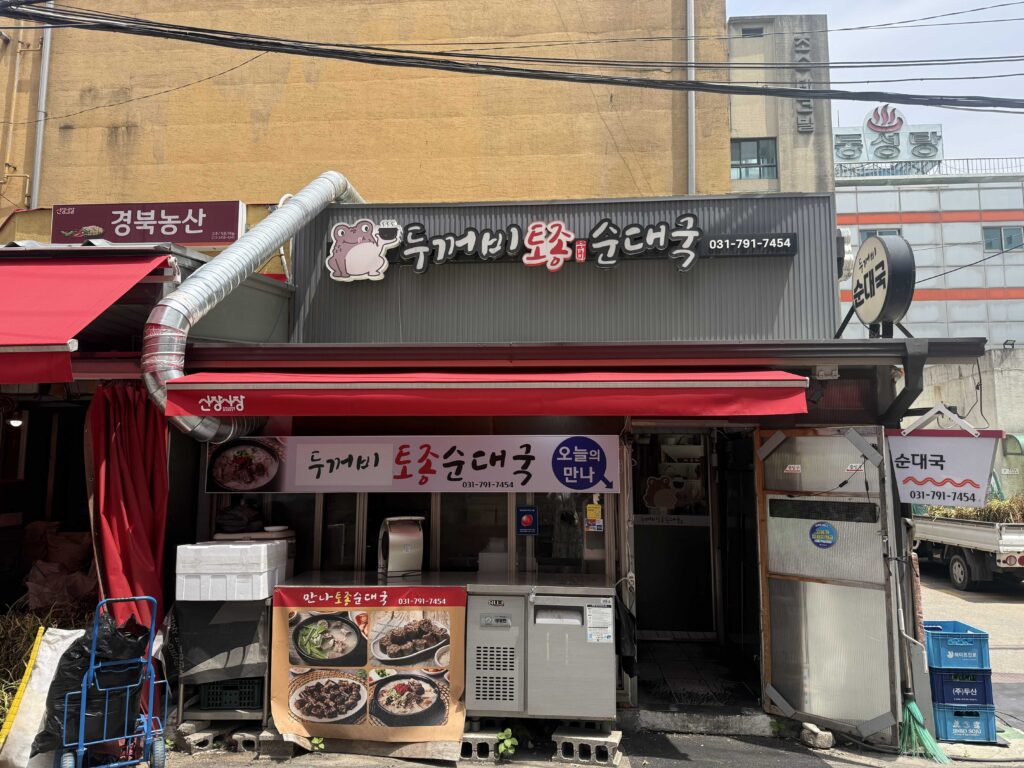
Dukkeobi Sundae Guk Hanam exterior with toad mascot sign at Sinjang Market entrance
The shop sits at the front of Sinjang Market.

At first, we had a grocery list and an empty stomach. Sinjang Market opens earlier than the supermarkets in our neighborhood. So we set out around eight in the morning to get the seafood and the dried goods done before the lunch crowd showed up. By the time we’d walked the first aisle and decided on the mussels, my older one was hungry. My younger one was hungrier. My wife was eyeing the corner shops for anything that opened before nine.

Then a toad sign caught my eye at the corner of the alley. I’d seen it for years and never gone in. It looked like a shop the regulars protect, a place you only enter when you have at least one local with you. We went in anyway. There was one older couple at the back table, a single delivery driver near the door, and a TV showing a midmorning news segment with the volume just barely on. Cold barley tea steamed off the warming pot near the counter, and the smell of bone broth hit us before we’d cleared the doorframe.

Inside, the owner waved us toward the counter without saying anything. She had a knife in one hand and a bunch of scallions in the other. That was the universal signal that she was busy but not annoyed. A second cook at the back of the room was pulling a fresh batch of cheek meat out of the pot, and the steam climbed in a thin column toward the ceiling fan.

Toad Mascot You Walk Past Three Times Before Noticing

Interior wide shot at Dukkeobi Sundae Guk Hanam with old Korean signs and wooden floor
Old wooden floor, faded signs, single rectangular room.

Exterior signage of Dukkeobi Sundae Guk Hanam is hard to read from the street. Two awnings, one red and one white, stack over the entrance. Painted toad sits in the gap between them. Phone number on the right (031-791-7454), a smaller secondary sign on the left advertising the daily meat special, and a chalkboard easel by the door with the morning’s banchan list.

On a Saturday morning the alley is filling with vendors setting up their stalls. So the shop competes with the smell of dried squid from next door. And with the racket of crates being unloaded across the street. If you’re walking the market, mark Dukkeobi Sundae Guk Hanam on your map first and head over before the rest of the alley wakes up. By 10:30 the line starts forming. Owners stop seating walk-ins around noon when their pre-orders pile up.

I always tell visiting friends that the toad on the sign is the giveaway. Once you spot the toad, you slow down. Slowing down means you smell the broth. After the broth hits, you stop pretending you’re going to walk to the next aisle. Most regulars do their loop the same way. Sundae guk first, then the rest of the shopping. Anything else is amateur work.

Inside Dukkeobi Sundae Guk Hanam on a Saturday Morning

Inside Dukkeobi Sundae Guk Hanam with window counter and red awning
Counter seats by the window.

Inside the shop is a single rectangular room with the kitchen open to the dining area. Wood-grain tables run down the middle. Counter seats line the front window. A red awning filters the morning light into the room and makes everything look slightly warmer than it is.

Beverage fridge and empty wooden tables at Dukkeobi Sundae Guk Hanam
Beverage fridge and the long wooden table.

Two beverage fridges sit against the wall, stocked with soju, beer, makgeolli, and the small plastic bottles of cold barley tea that you grab for the kids. Above the fridges, a shelf holds extra ceramic bowls in stacks of ten. A kitchen pass-through window opens to the back, where the broth pot is on a slow simmer that you can hear from your seat.

After we sat down, we took the four-seat table on the right side, the one with the red awning’s color falling across it. My older one immediately spotted the cold barley tea fridge and grabbed two bottles. My younger one was already trying to read the menu board on the wall, which he can sort of do if the characters are big enough. He sounded out the price for 순대국 (sundaeguk, Korean pork bone soup) and reported it like he’d cracked a code.

Two delivery drivers came in five minutes after we sat down. Both ordered without looking at the menu and grabbed seats at the counter. Behind them, an elderly woman walked straight to the kitchen pass and started chatting with the second cook in the kind of casual rhythm that only happens between regulars. We sat there listening, drinking the tea, and watching the morning light shift slowly across the wooden tables.

The Menu Board That Has Not Been Redone in Years

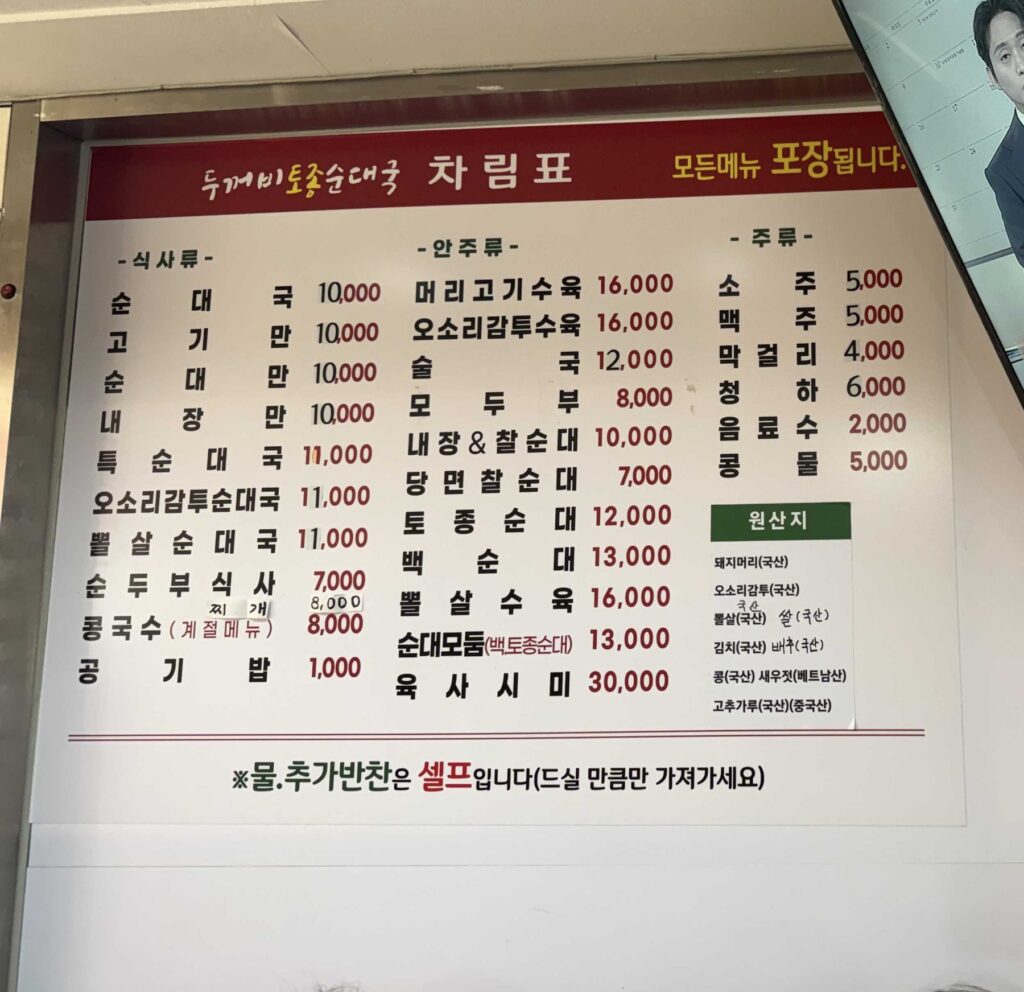
Menu board with prices at Dukkeobi Sundae Guk Hanam Sinjang Market
Menu board lists everything from sundae guk to suyuk and seasonal kongguksu.

The price board is split into three columns. Soup dishes on the left, suyuk and side platters in the middle, and drinks on the right. It is the kind of board that has been re-painted maybe twice in twenty years, with a small “포장 가능 (takeout available)” stamp added at the top later.

  • Sundae guk (pork bone soup with blood sausage) ₩10,000
  • Gogi-man (meat-only) ₩10,000
  • Sundae-man (blood sausage only) ₩10,000
  • Naejang-man (innards only) ₩10,000
  • Teuk-sundae-guk (premium with extra cuts) ₩11,000
  • Osori-gamtu-sundae-guk (pig stomach cut) ₩11,000
  • Bbol-sal-sundae-guk (cheek meat) ₩12,000
  • Toojong-sundae (pork-only blood sausage plate) ₩12,000
  • Baek-sundae (white-style soup) ₩13,000
  • Meori-gogi suyuk (boiled pork head meat) ₩16,000
  • Osori-gamtu suyuk (pig stomach platter) ₩16,000
  • Yuk-sa-shi-mi (raw beef sashimi) ₩30,000
  • Kongguksu (seasonal soybean cold noodle) ₩8,000
  • Kongmul (soybean drink) ₩5,000

Once the menu was on the table, we ordered three regular sundae guk bowls and one baek-toojong (white-style) bowl, then a single rice add-on. Three bowls felt right for four people, since the kids share a bowl with rice mixed in and we each get our own. The owner asked which one we wanted with extra meat. I pointed at my younger one without saying anything. She nodded and disappeared back into the kitchen.

Two Bowls Compared at Dukkeobi Sundae Guk Hanam — Red and White

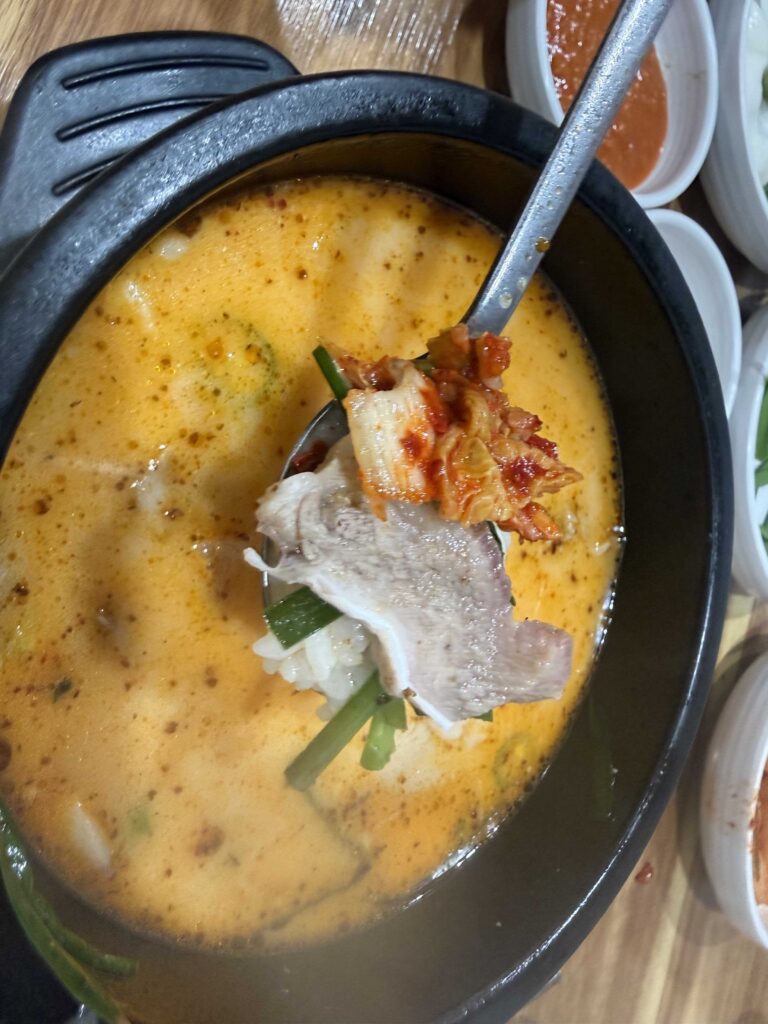
Red broth sundae guk at Dukkeobi Sundae Guk Hanam with beef slice and kimchi on spoon
Red broth bowl with a beef slice and a piece of kimchi on the spoon.

The first bowl arrived with the red film on top. Chili oil floated in irregular patches, scallions chopped fine, and a single slice of cheek meat resting on a pile of rice at the bottom. The smell came up in a single wave — porky, smoky, with that low note of seujeotgal (salted shrimp paste) you only get in shops that haven’t switched to bouillon shortcuts.

Short pan across the red broth bowl.
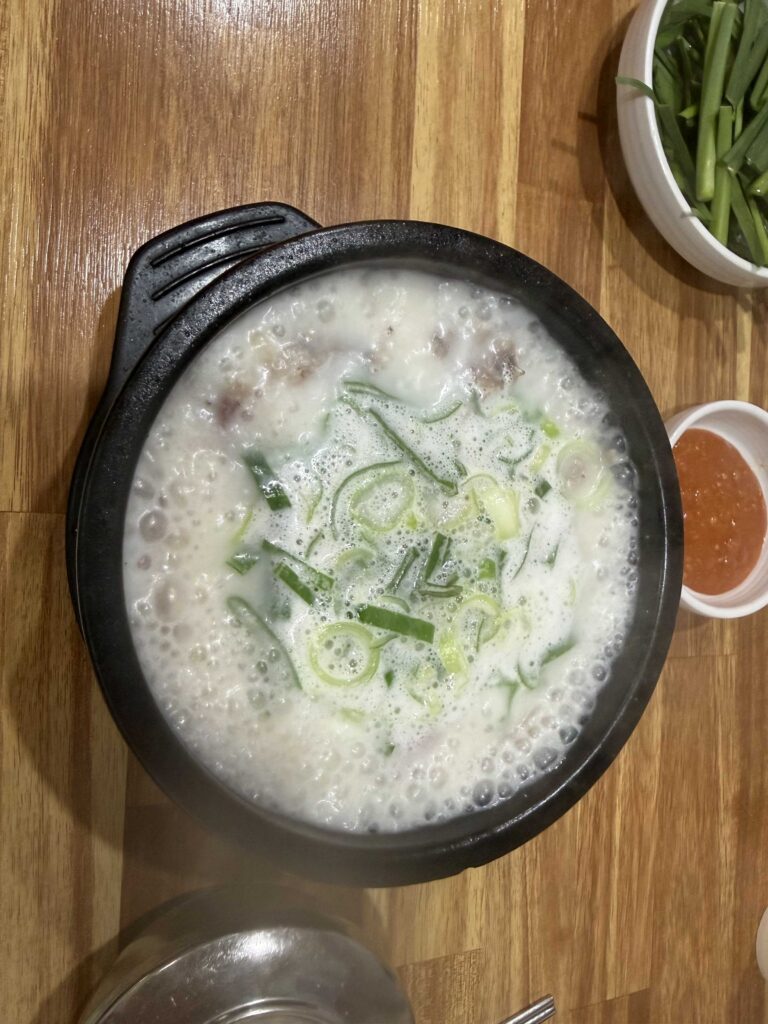
White broth baek sundae guk with chopped scallions at Dukkeobi Sundae Guk Hanam
White broth baek-toojong bowl.

The white bowl came out a minute later. Same base broth, but without the chili oil pressed in. The scallions were heavier on this one. Ground black pepper dusted the surface and dissolved into the broth as soon as you stirred.

Stirring scallions into the white broth.

If you’re new to Korean pork bone soup, the distinction matters. Red bowl tastes louder. White bowl tastes longer. We always order one of each so the kids can pick which one their tongues prefer that morning. On this visit, my older one went for the red. My younger one stayed loyal to the white.

Also a side note on the chili oil. It is not the bottled, mass-produced variety you find in chain restaurants. This one looks hand-pressed, with sediment at the bottom and a slight smoke note that comes through when the bowl cools by a few degrees. I asked the owner about it once. She shrugged and said the cook makes it on Mondays.

Beef That Gave Way Under the Spoon

Close-up of beef and kimchi on a spoon in Dukkeobi Sundae Guk Hanam red broth
Tender beef and the kimchi that came on top.

At first, I had not expected the meat to be this tender. Sundae guk shops vary, and a lot of the older ones over-boil the cuts into rubbery strips that you push to the side of the bowl. Not here. The beef at Dukkeobi Sundae Guk Hanam came off the bone with a gentle press of the spoon. It practically melted in the broth, with just enough chew to remind you that it had been a piece of muscle and not paste.

Then I lifted a spoonful with a wedge of kimchi balanced on top, and the kimchi did its job. The acidity cut through the richness. The two flavors balanced for about a second before merging into something that tasted like a memory of every winter market I’d ever eaten at. Both my wife and I went quiet for the next three minutes.

My older daughter copied the spoon-with-kimchi move and pronounced it “the best part.” She is ten years old and her food vocabulary is limited. But this style of broth tends to flatten the vocabulary anyway. If a ten-year-old says “best part” without prompting, you stop second-guessing the dish.

What Each Cut Tasted Like

We compared notes on the beef cuts after the meal. I had pulled what looked like cheek meat, my wife had a piece of front shank, and our daughter had a small chunk that might have been brisket. All three came apart with the spoon. All three had absorbed enough broth to taste like the broth itself. That is the test for a good sundae guk pot. If the meat tastes like rinsed protein when you bite into it, the shop has been cutting corners with bouillon. If the meat tastes like the bowl, the broth has been on the stove long enough. Both my wife and I agreed without saying it out loud that we’d be back for the cheek-cut bowl on the next visit.

The Banchan and the Self-Serve Counter

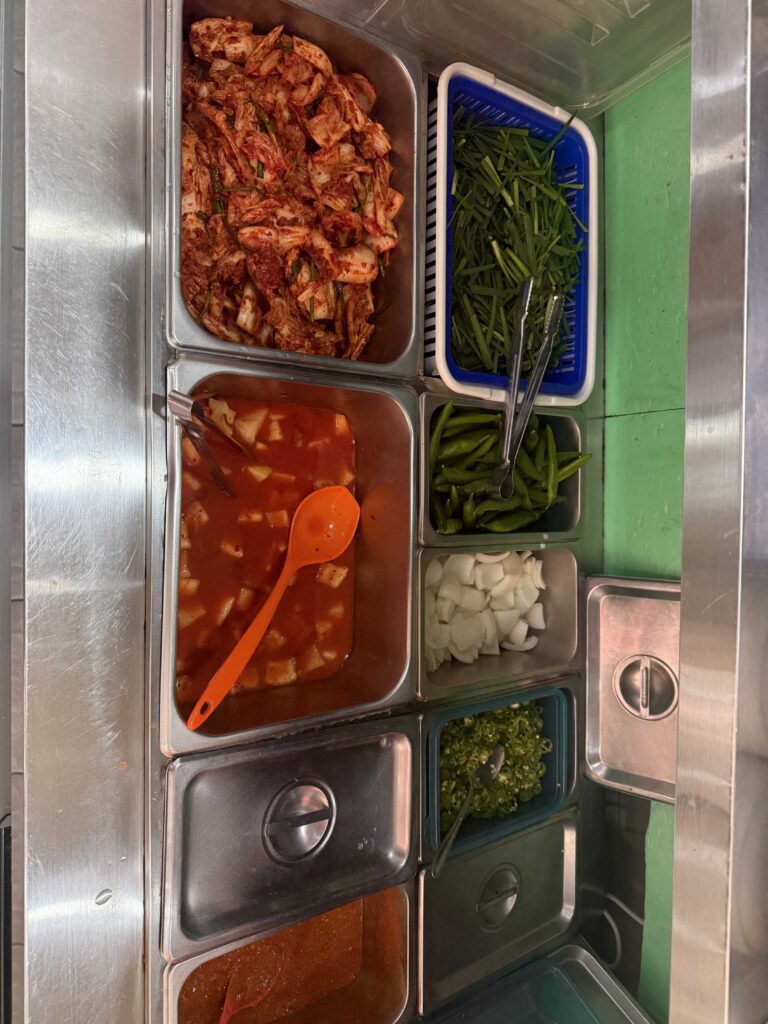
Self-serve banchan station with kimchi greens onion and chili at Dukkeobi Sundae Guk Hanam
Self-serve banchan station near the kitchen.

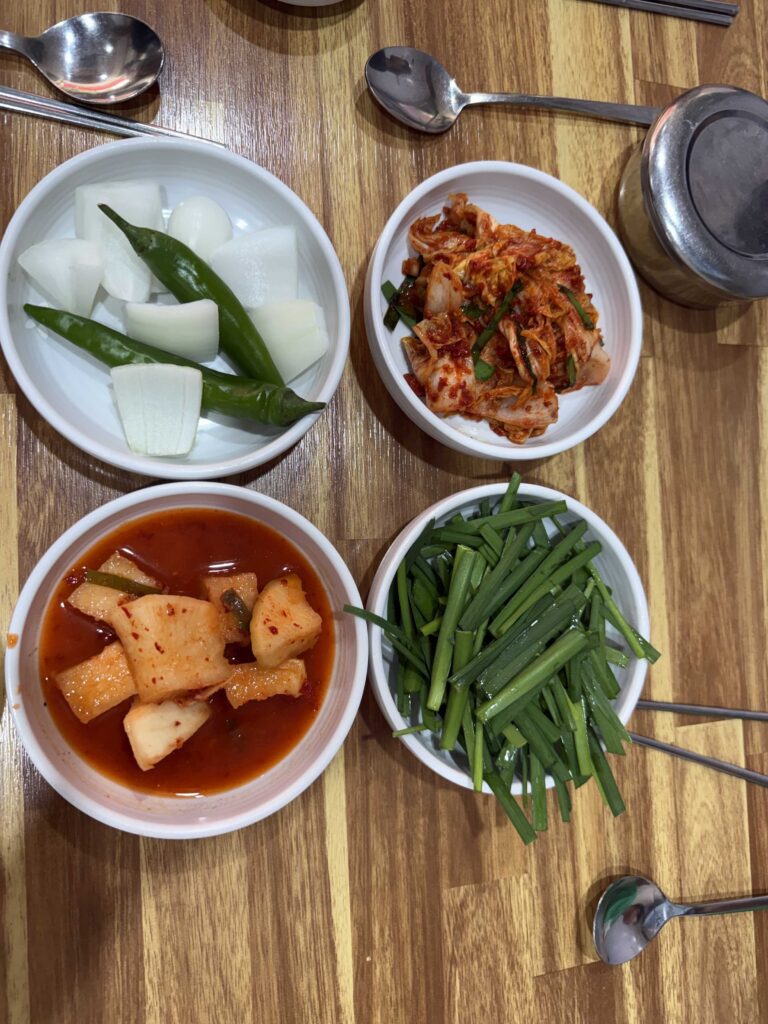
Most sundae guk shops set the banchan on your table when you order. Dukkeobi Sundae Guk Hanam runs a self-serve setup near the kitchen pass instead, with a row of metal trays in chilled compartments. Kimchi, pickled radish (mu), raw green chilis, sliced onion in vinegar, and chopped chives sit ready in big batches. A small ladle for each compartment. A short stack of refill plates on the side.

Four side dishes plated at Dukkeobi Sundae Guk Hanam with kimchi pickled radish chili and chives
Four side dishes on a single tray.

The chives surprised me. Fresh, slightly bitter, chopped just enough to drop into the broth as a garnish. I dropped a small mound into the red bowl and watched the green darken in the chili oil. The chives turned the bowl into something brighter, more like a fresh stew than a heavy soup.

Self-serve banchan does require parents to make a few trips. My older one went up twice on her own for refills, which she treated as a small adventure. Worth noting if you visit with younger kids who can’t carry a plate without spilling. Assign one parent to refill duty in advance and you keep the meal smooth.

The pickled radish at this shop is sharper than what you usually get at sundae guk stops in Songpa. A bit more vinegar, a bit less sugar. It cuts through the fat of the broth without making the bowl taste sour. My wife always asks for a small side of it to keep on the table even after we’ve moved to the main bowls.

How Four of Us Split Three Bowls

We did the bowl math at the door. Three regular sundae guk for the adults and our older daughter, plus one baek-toojong shared between us. That sounds like a lot, and it was, but the bowls are sized for adults and our younger one wasn’t going to finish a full one on his own.

First, we split it the way we usually split a hot soup with kids. Pour a portion into a small ceramic bowl, drop in a spoon of rice, top with a few pieces of meat from the parent bowl. Stir until the rice cools enough to eat. By the time he was on the second spoon, my younger one had stopped fidgeting and was eating with both hands on the bowl. That’s the sign you wait for.

Meanwhile, my older daughter handled her bowl solo. She added kimchi by the chopstick-load and took a refill of pickled radish halfway through. My wife and I ate without saying much for the first five minutes. We’ve had enough breakfasts in Hanam to recognize a good one without having to comment on it out loud.

If you ever wonder whether sundae guk works for kids, this shop is a good test. The broth is rich but not heavy. The meat is soft. There are no surprise textures that throw kids off. We came out with my younger one asking when we could come back, which is the only review metric that matters.

What the Morning Bill Looked Like

In short, the total damage at Dukkeobi Sundae Guk Hanam for four people was ₩31,000. Three sundae guk at ₩10,000 each, one rice add-on at ₩1,000. We skipped the suyuk and the kongguksu since we still had grocery shopping ahead of us. For a hot Saturday breakfast that left two adults and two kids satisfied, the price-per-mouth was hard to beat anywhere else in Hanam.

By comparison, we paid almost double last month for a similar weekend breakfast at ChaCha Bakery Gamil around the corner. Bakery breakfasts are great for a treat, but they don’t fill the kids up the way a bowl of broth does, and they tend to bottom out two hours later when the sugar crashes.

On a budget-per-warmth basis, sundae guk wins. On a market-morning routine basis, this shop wins. The combination puts Dukkeobi Sundae Guk Hanam at the top of our short list for breakfast spots when we have weekend market errands.

Add the cold barley tea and the self-serve banchan into the math and the meal feels even cheaper than the receipt says. Two adults, two kids, three bowls of broth, a small mountain of side dishes, and a bottle each of cold tea. Total under thirty-five thousand won. If we had stopped at the convenience store on the way to the market and grabbed pre-made gimbap and triangle kimbap instead, we would have spent close to twenty thousand for less food and zero atmosphere.

Family Verdict Score Card

Three bowls, two kids, and one Saturday morning later, here is how the meal scored across the categories we usually track for family-friendly Korean food spots.

  • Beef Tenderness 5 / 5. The meat came off the bone with a spoon press.
  • Broth Depth 4.5 / 5. Long finish, real pork bone base, no shortcut bouillon notes.
  • Banchan Variety 4 / 5. Self-serve setup, five rotating items.
  • Family Fit 4 / 5. Bowls split well for younger kids.
  • Value 5 / 5. ₩10,000 for the regular bowl, hard to beat in Hanam.
  • Market Atmosphere 3.5 / 5. Old shop charm, busy on weekends, not a date-night place.
  • Overall 4.3 / 5.

How to Find the Place and What to Order

Dukkeobi Sundae Guk Hanam sits at the southern entrance of Sinjang Market. From the main road, you walk in past the dried-goods stalls and the shop appears on your right within about thirty steps. If you cross the alley junction, you’ve gone too far.

  • 📍 Address. Sinjang Market entrance, Hanam-si, Gyeonggi-do
  • 🗺️ Map. Google Maps
  • 📞 Phone. 031-791-7454
  • 🕒 Hours. Open from around 8 a.m., kitchen winds down by mid-afternoon
  • 🅿️ Parking. Market lot ₩500 per 30 min, fills up by 10:30 a.m. weekends
  • 💰 Menu range. ₩10,000 to ₩30,000
  • 🥢 Order tip. Get one red and one white if it’s your first visit
  • 🍴 Takeout. Available, ask the owner directly

Once you want background on what sundae actually is before ordering, the Wikipedia entry on sundae (Korean blood sausage) covers the regional variations and the history of the dish.

Why We’ll Come Back

We left around nine in the morning with our grocery list still half undone. My older one carried the cold barley tea bottles like trophies. Our younger one wanted to keep the spoon, since he didn’t get to, but he asked. Both of us parents walked the next aisle of the market in the kind of warm-stomach silence that makes shopping easier.

Soon after this visit, I added Dukkeobi Sundae Guk Hanam to my phone’s regular rotation alongside Pocha Cheonguk Hanam for evenings and Chaesundang Hanam Misa for weekday family lunches. We also still hit Jjokgalbi Gamil when we want pork ribs without the soup. And on Konkuk study trips with the kids, 502 Jjigae Maeul Konkuk stays in our weeknight loop.

But for Saturday morning Sinjang errands, Dukkeobi Sundae Guk Hanam is now the default. We’ll be back next weekend.

Lastly, if you are putting together a Hanam food map of your own, this shop deserves the same kind of attention you’d give a long-standing pork belly grill or a market hwesenta. It does one thing. It does it cleanly. And it has done it the same way for long enough that the regulars don’t bother asking how it’s going. They just walk in, sit down, and wait for the bowl to come out.

Leave a Comment

Your email address will not be published. Required fields are marked *

Scroll to Top