
Late-night gukbap was not on my plan that Tuesday. I’d been at the office past 7 p.m. wrapping up a deadline, and a coworker mentioned the steam rising off bowls at Dammion Seongsu (담미온) — a Korean gukbap restaurant in the Seongsu food strip we’d both visited before. We grabbed our laptops, walked the four blocks over, and ordered three things: an eolkun gukbap (spicy pork stew) for me, a budae gukbap special for him, and a bossam set neither of us had planned to add. We sat down at 8 p.m. and didn’t leave until 9 p.m. No alcohol — just Coke. The eolkun gukbap turned out to be the surprise pick of the night.
Why We Walked Out for Late-Night Gukbap After Overtime
Korean office workers tend to default to two food options after late-night work: convenience-store kimbap or a quick stop at a gukbap joint. Gukbap (국밥) is the practical choice when you’re tired, slightly hungry but not starving, and need something hot and savory before walking home. Dammion sits a few minutes from where I work in Seongsu, and on this particular Tuesday, the timing lined up perfectly.
I’d written about Dammion before from a different angle — that earlier visit covered the budae and suyuk gukbap as part of a broader family-style review, and you can read it on our original Dammion Seongsu review. This second visit was a different scenario entirely. No family. No leisurely Saturday afternoon. Just a coworker, two laptops we left in our bags, and a hunger that needed something heavier than ramen.
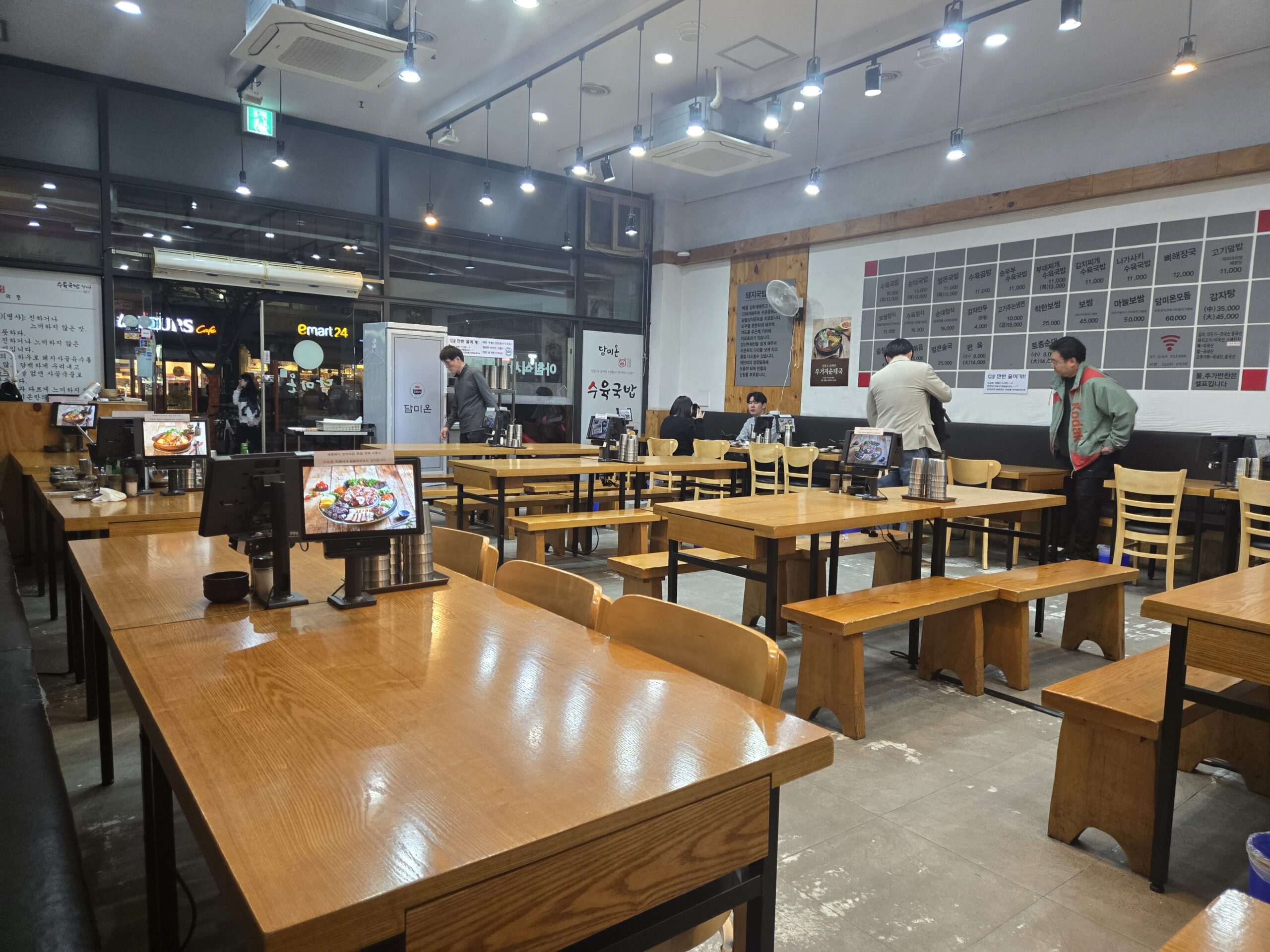
So we walked the four blocks over from the office. Seongsu in late evening has a specific energy — most of the cafes have closed, the design studios have wrapped, but the restaurant strip stays alive until about 11 p.m. Dammion was lit up and busy when we arrived. About 70% of tables full. Most groups looked like office workers in similar after-overtime states.
Inside Dammion Seongsu on a Tuesday at 8 p.m.
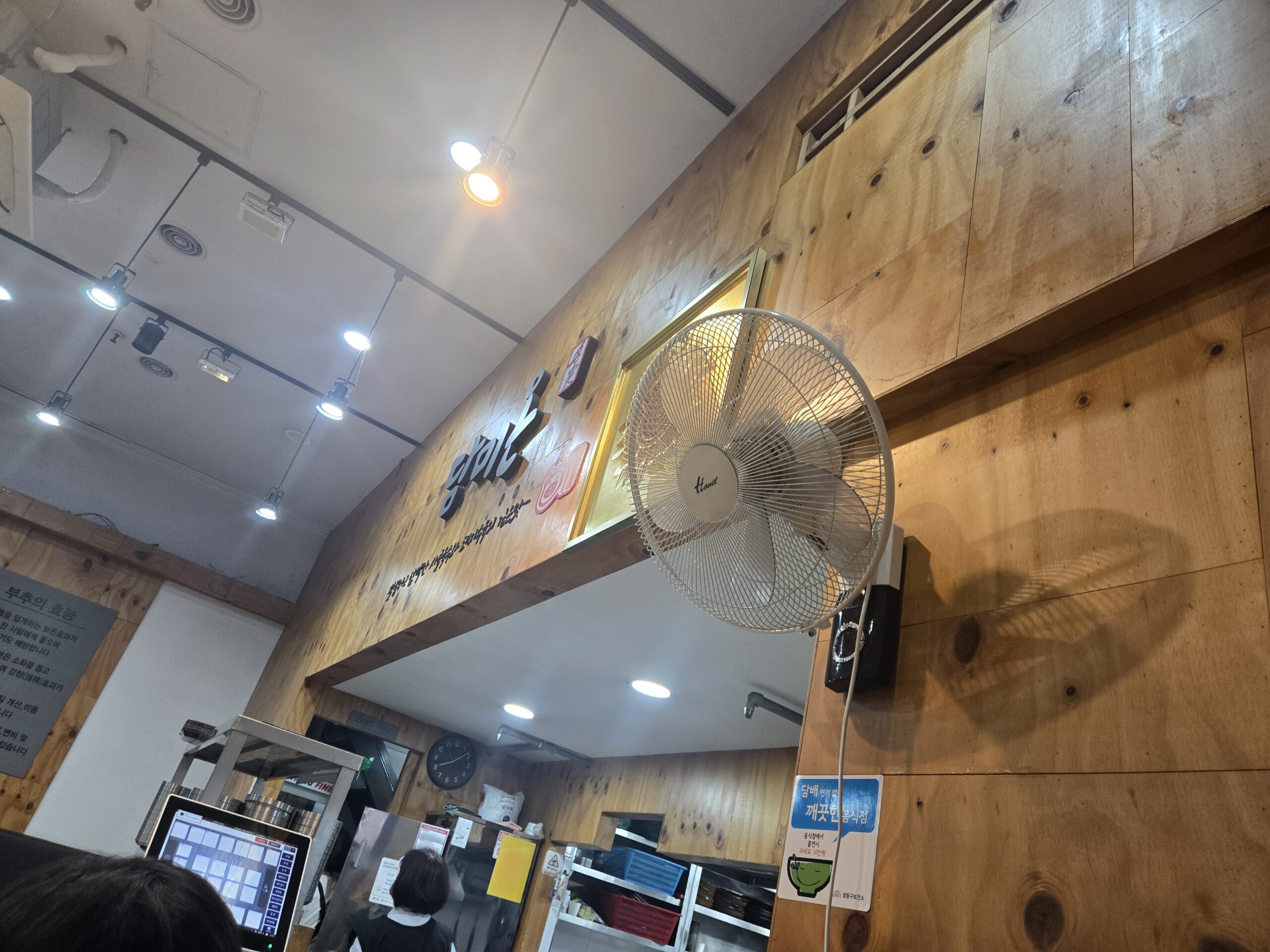
Wooden interior. Plywood walls, exposed ceiling track lighting, wooden chairs around long communal tables. The Dammion logo (담미온) sits high on the back wall in raised wooden letters. A wall-mounted fan spins slowly in one corner. The vibe leans casual-Korean-pub more than upscale-restaurant — the kind of place where you can show up in office clothes or in joggers and nobody notices either way.
Most groups at 8 p.m. were eating gukbap. Looking around, almost every table had at least one bowl of something steaming — eolkun gukbap, budae, suyuk, sundae. A few tables had bossam plates with the long pork-belly slices arranged like dominoes. Drinks split roughly between soju, beer, and soft drinks. We’d noticed during our previous visit that Dammion’s gukbap-to-soju ratio runs higher than most Korean pubs, which means people come here to eat first and drink second.
Service was quick on a Tuesday night. We were seated within two minutes of walking in. The staff brought water, set up the tablet, and disappeared. Korean restaurants vary widely on tablet adoption — Dammion has fully committed. Once you sit down, the rest of the meal flows through the screen.
Tablet Menu and Why Spicy Gukbap Caught My Eye
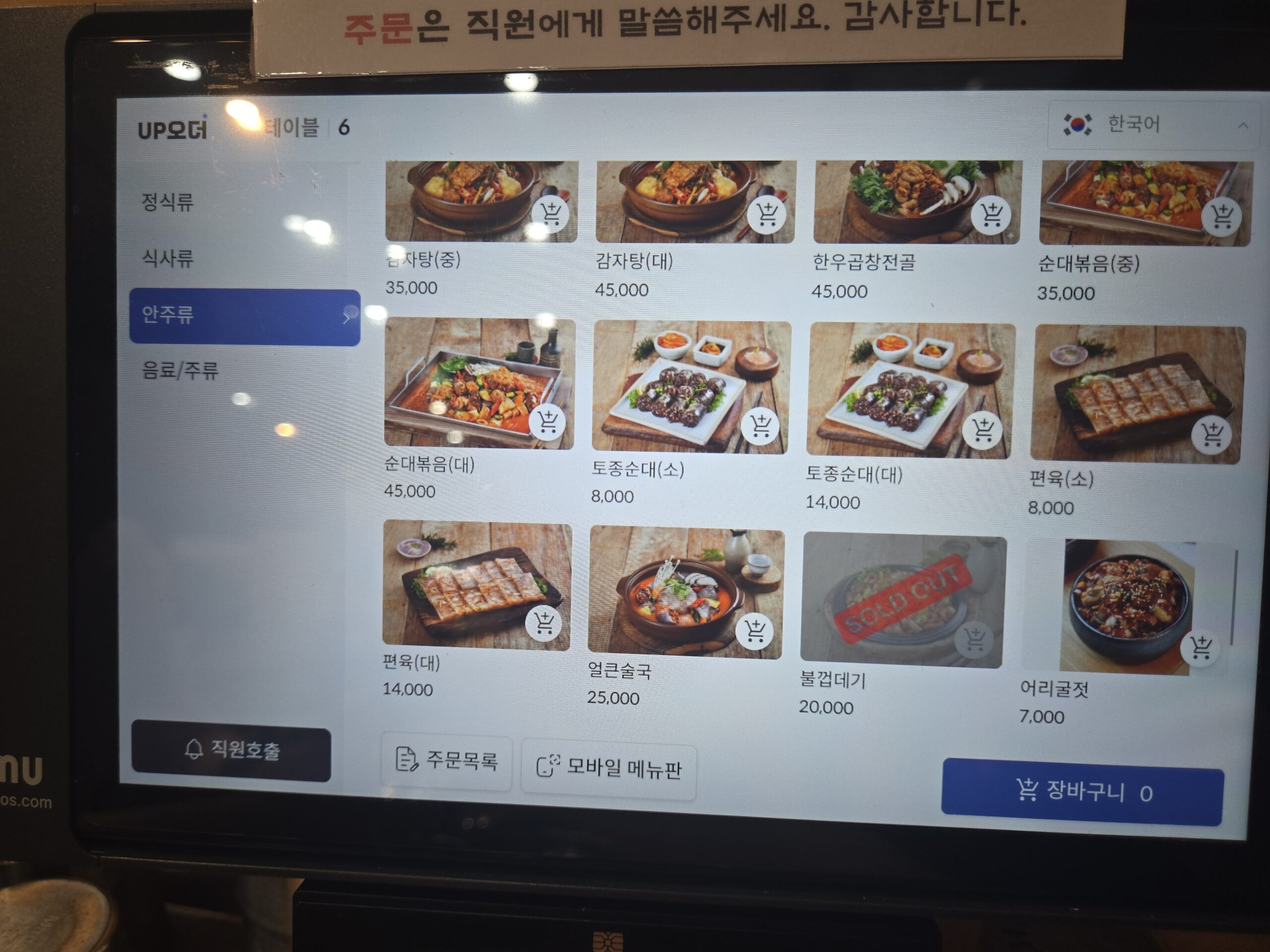
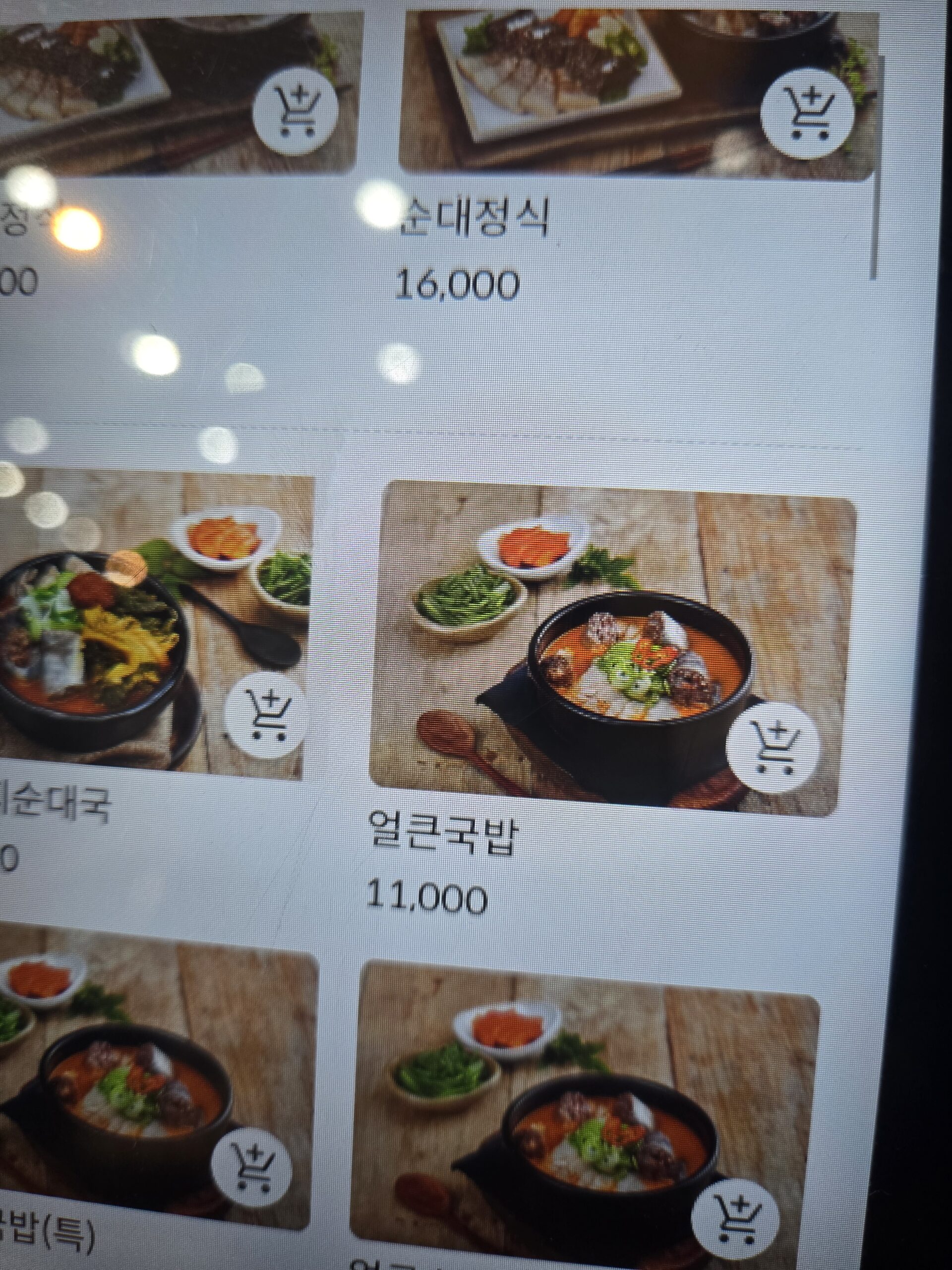
Ordering at Dammion uses the UPorder tablet system — same setup we’ve seen at Pocha Cheonguk Hanam and a handful of other modernized Korean restaurants. Categories on the left: 정식류 (set meals), 식사류 (rice dishes), 안주류 (drinking snacks), 음료/주류 (beverages and alcohol). Photos for every dish. Korean-English toggle in the top-right corner.
The 식사류 section had what I came for. Eolkun gukbap (얼큰국밥) at 11,000 KRW, sundae jeongsik (순대정식) at 16,000 KRW, and budae(특) (the special-grade budae gukbap) at 13,000 KRW. Photos showed each bowl with side dishes and a little sausage chip on top of the budae. Sundae jeongsik came with a separate plate of slices. The pricing across the board landed at typical Seongsu lunch-spot levels — slightly above suburban gukbap but below Gangnam restaurant tier.
I’d never tried the eolkun gukbap before. Most of my previous Dammion visits had been budae or suyuk. So when my coworker said he was getting the budae(특), I picked the eolkun on impulse. The photo on the tablet showed a deeper red broth than the regular budae, with thinner pork strips on top and a leek-heavy garnish. It looked like the kind of stew that would sit on the spicy edge without crossing into pure capsaicin. I went for it.
Eolkun Gukbap (얼큰국밥): The First-Time Order
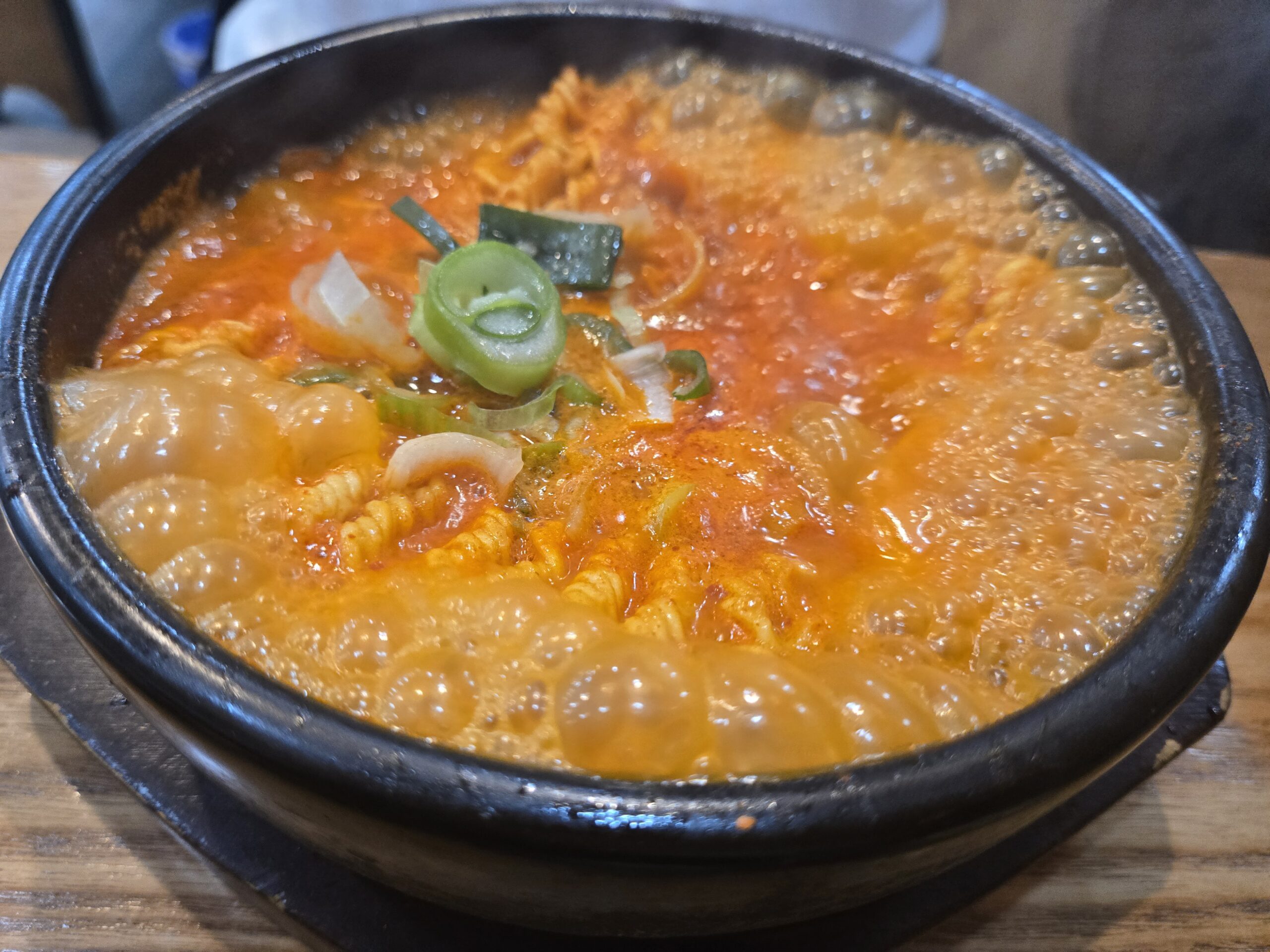
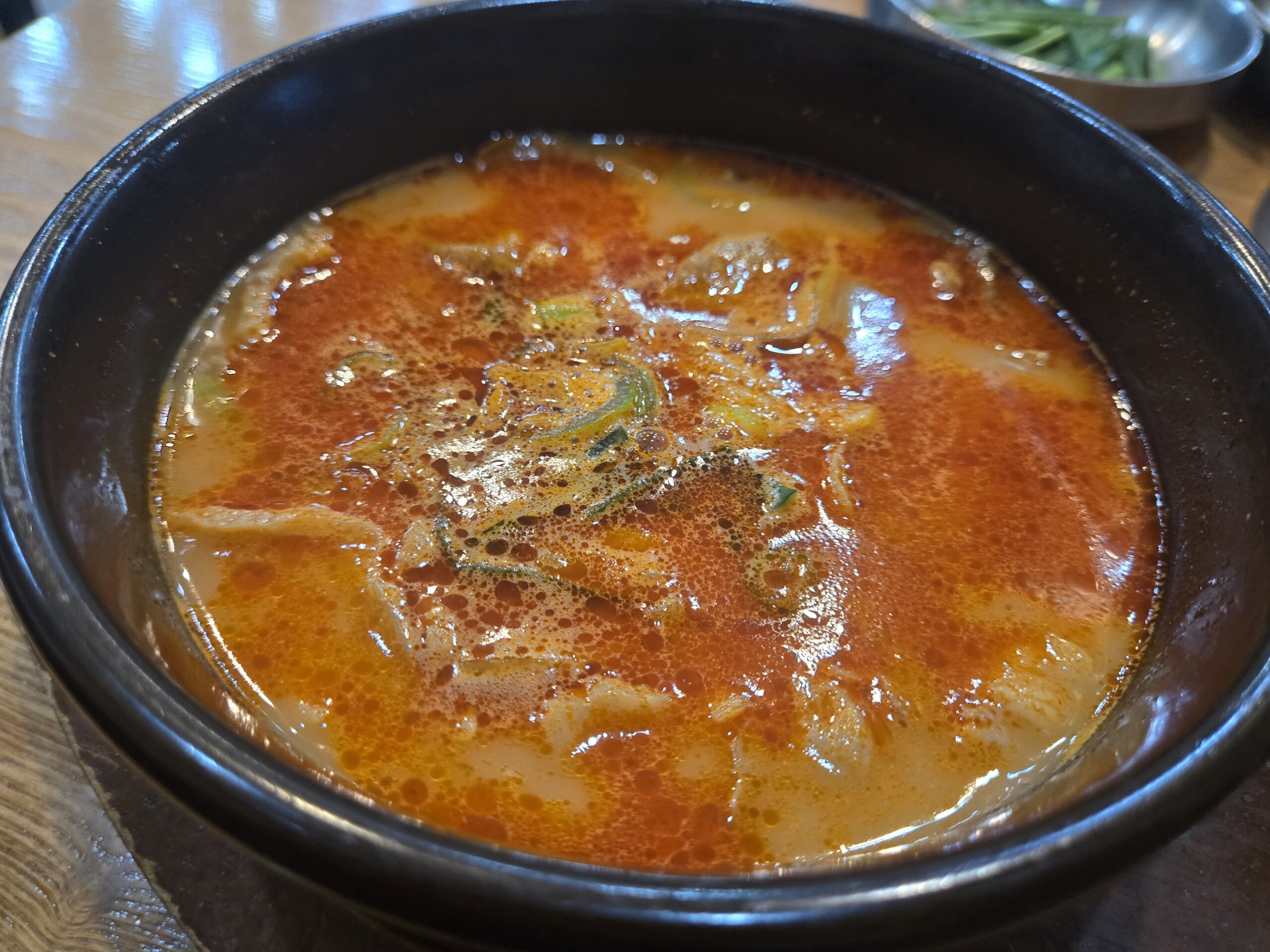
Bubbling stone bowl arrived first. The eolkun gukbap landed at the table with the broth still rolling at a low boil, surface scattered with chopped leek, a pile of thin pork-belly slices on top, and a clear sheen of chili oil floating across the rim. First impression: spicier than the photo suggested. Second impression: deeper savor than I’d expected from a 11,000 KRW gukbap.
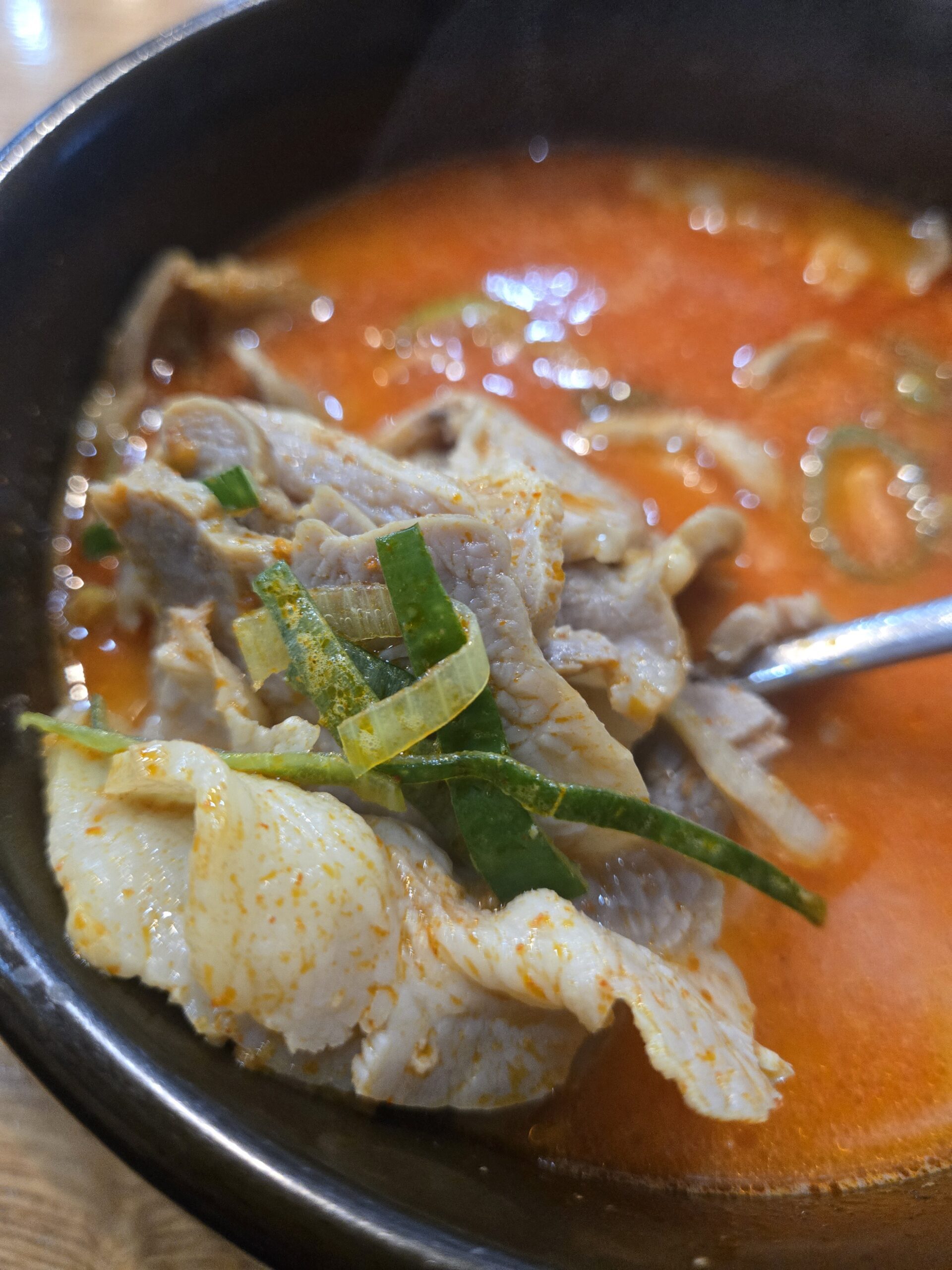
I dipped a spoon in for a test sip. Heat hit first — Korean chili heat, not the slow-burn type from chili pepper but the immediate front-of-mouth tingle that comes from gochugaru (fermented chili powder) cooked into a meat broth. Then came the depth. The broth had clearly been simmered with pork bones for hours, and the resulting body was thick enough to coat a spoon. The leek added freshness against the heat. Pork-belly slices stayed tender — neither chewy nor falling apart.
A Note on Korean Spice Levels
Eolkun gukbap is the Korean spicy variant of regular gukbap. The “eolkun” (얼큰) describes a specific kind of spice — the sweat-on-your-forehead, breathe-through-your-nose level that pairs with rice and alcohol. Most Korean gukbap restaurants offer either a clear broth or this spicy version. Dammion’s version landed at the spicier end of what I’ve had in Seongsu. Honest 7 out of 10 on the heat scale by Korean standards. Translates to a 9 for non-Korean palates.
For visiting families: eolkun gukbap is too spicy for kids who don’t already handle Korean spicy food. Stick with the budae or the regular gukbap if you have younger eaters. Adults who like spicy ramen will find Dammion’s eolkun a step up — closer to a stewed jjamppong than a typical Korean gukbap.
Budae Gukbap Special (부대국밥 특): My Coworker’s Pick
Coworker went with the budae(특) at 13,000 KRW — the special-grade version that adds extra Spam, sausage, and ramen noodles compared to the regular budae. Korean budae jjigae has its own history — it dates to the post-Korean-War era when American military bases left behind processed meats that Koreans incorporated into stew. The “특” (special) tier is the abundance version, designed for people who want the full nostalgia hit.
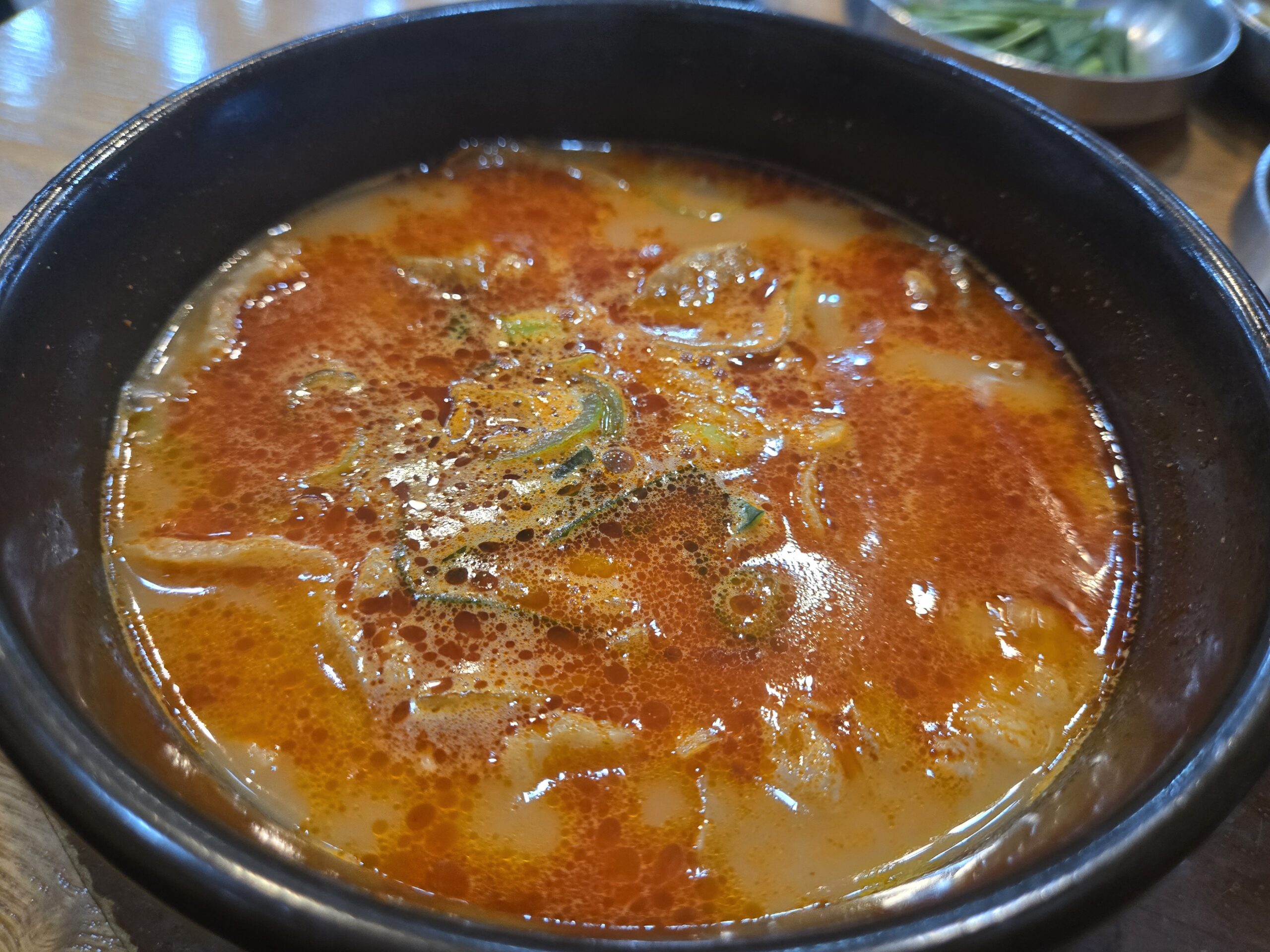
His bowl arrived smaller than my eolkun but visually busier. Ramen noodles tangled across the surface, alongside chunks of Spam, sliced sausage, kimchi, soft tofu, and a few green chili rings. The broth ran less spicy than mine — closer to a 4 or 5 out of 10 — but with the same long-simmered pork-bone richness underneath. He took a bite of the noodles and made the universal Korean office-worker face that means “this is exactly what I needed.”
We swapped a few bites halfway through. His budae had more variety per spoonful — every scoop hit a different ingredient. Mine had more depth, but a single texture profile (broth + pork strip + leek). For an office-worker dinner that needs to fill you up after a long day, his choice probably wins. For a flavor-focused dinner where you want one clean idea executed well, mine wins. Both worked.
Bossam Set (보쌈정식): The Unplanned Add-On
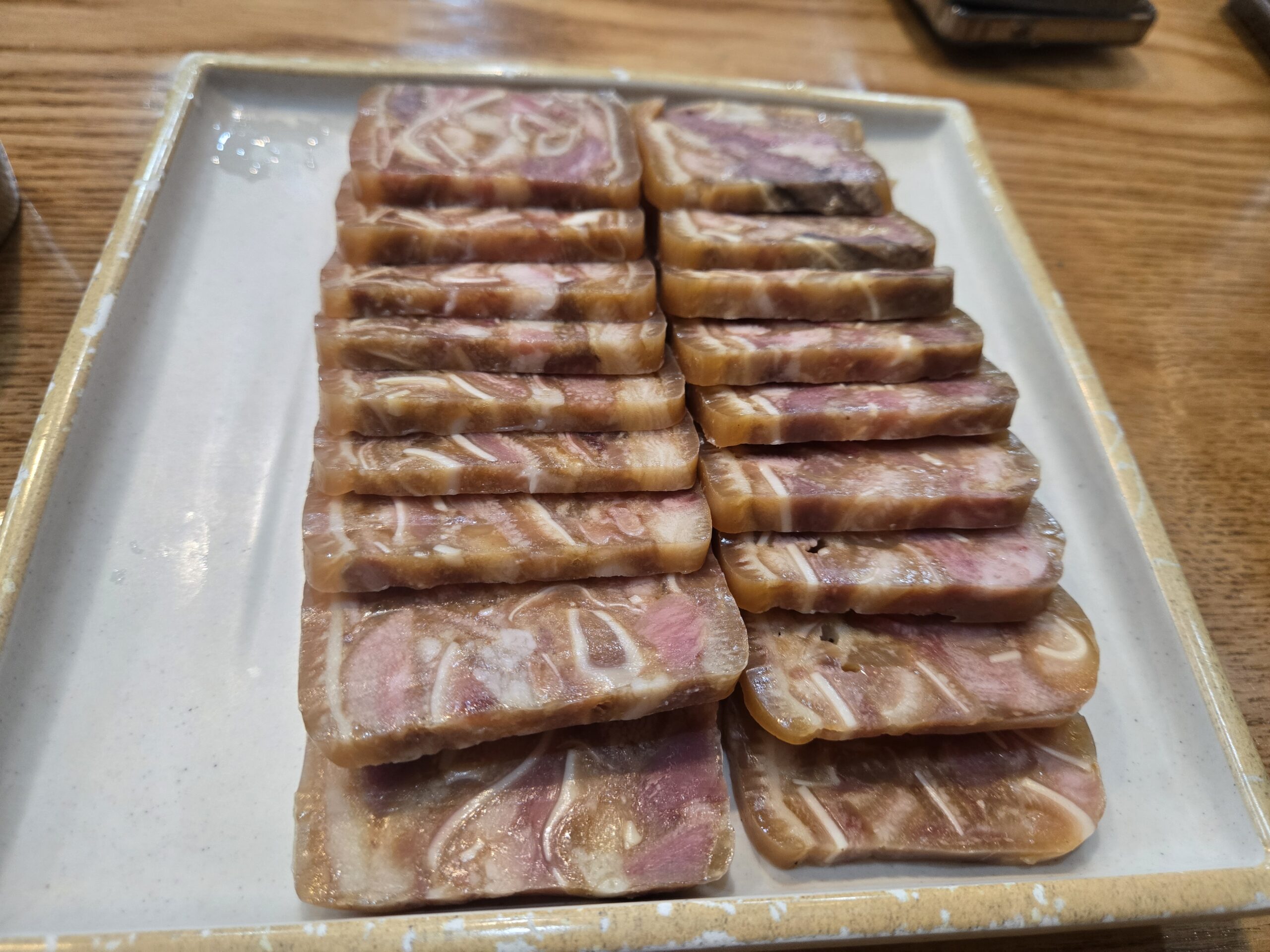
Halfway through the gukbap order, my coworker decided he wanted bossam too. (The Korean budae had reactivated his appetite in a way that gukbap alone wouldn’t have managed.) So we added a bossam set — pyeonyuk (편육) on the menu, similar to bossam — at 14,000 KRW for the large size. About a minute later the plate arrived with eighteen slices of boiled pork belly arranged in two columns, plus a small set of sides on the next tray.
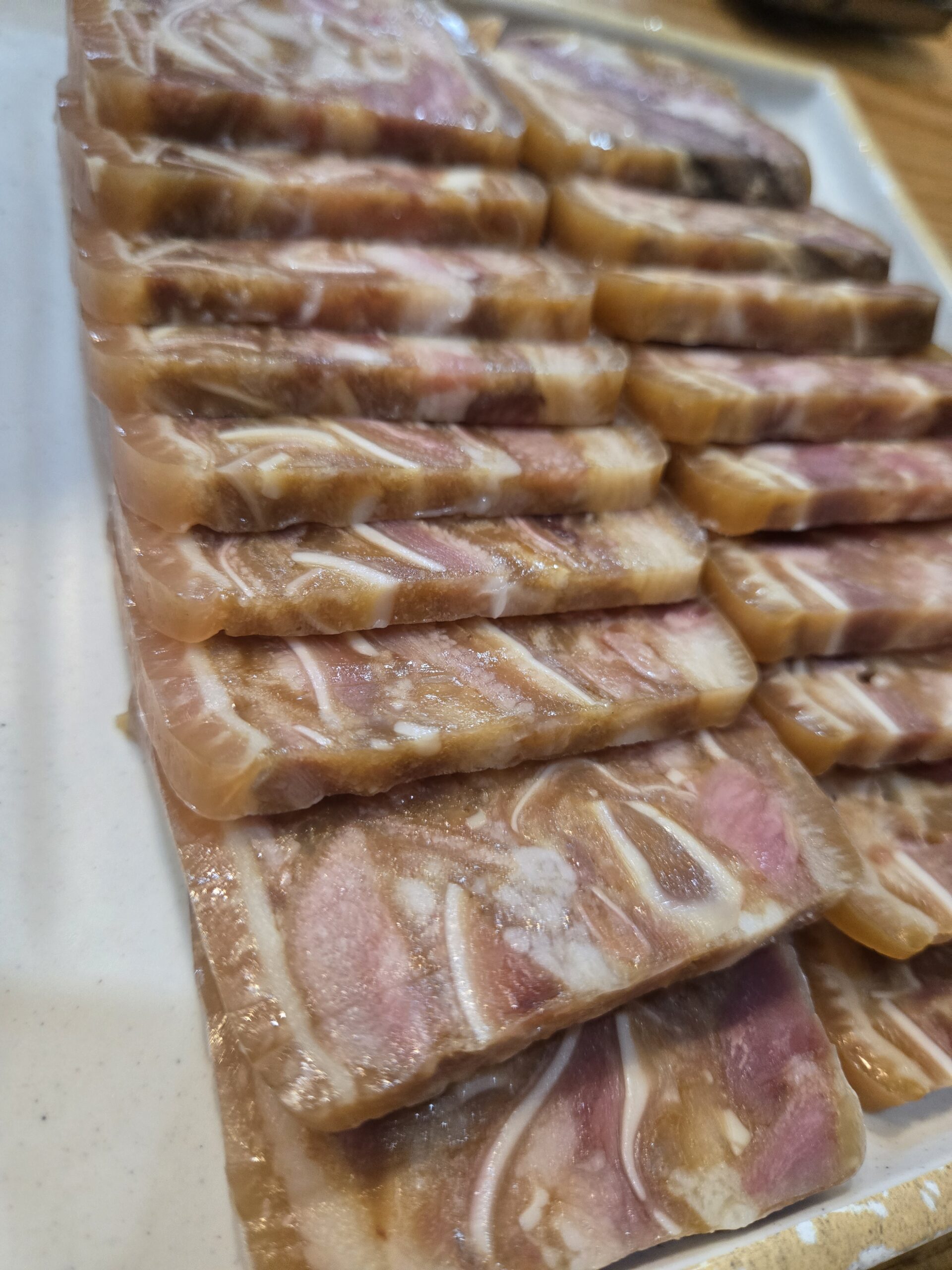
Bossam slices at Dammion arrive cold-boiled — pork belly that’s been simmered with aromatics, then chilled and sliced thin. The fat marbling stayed visible in each slice. Texture sat between soft and chewy, with the lean meat tender enough to bite without effort. Wrapped in cabbage with ssamjang and a piece of garlic, each bite landed exactly the way bossam should — clean, savory, restorative.
Pairs surprisingly well with eolkun gukbap. Spicy stew flavors hit hot, then a cold bossam slice resets the palate, then back to the stew. We alternated this rhythm for a solid fifteen minutes. By the time the bossam plate was empty, we’d both gone back for second helpings of the broth.
Side Dishes That Held the Whole Meal Together
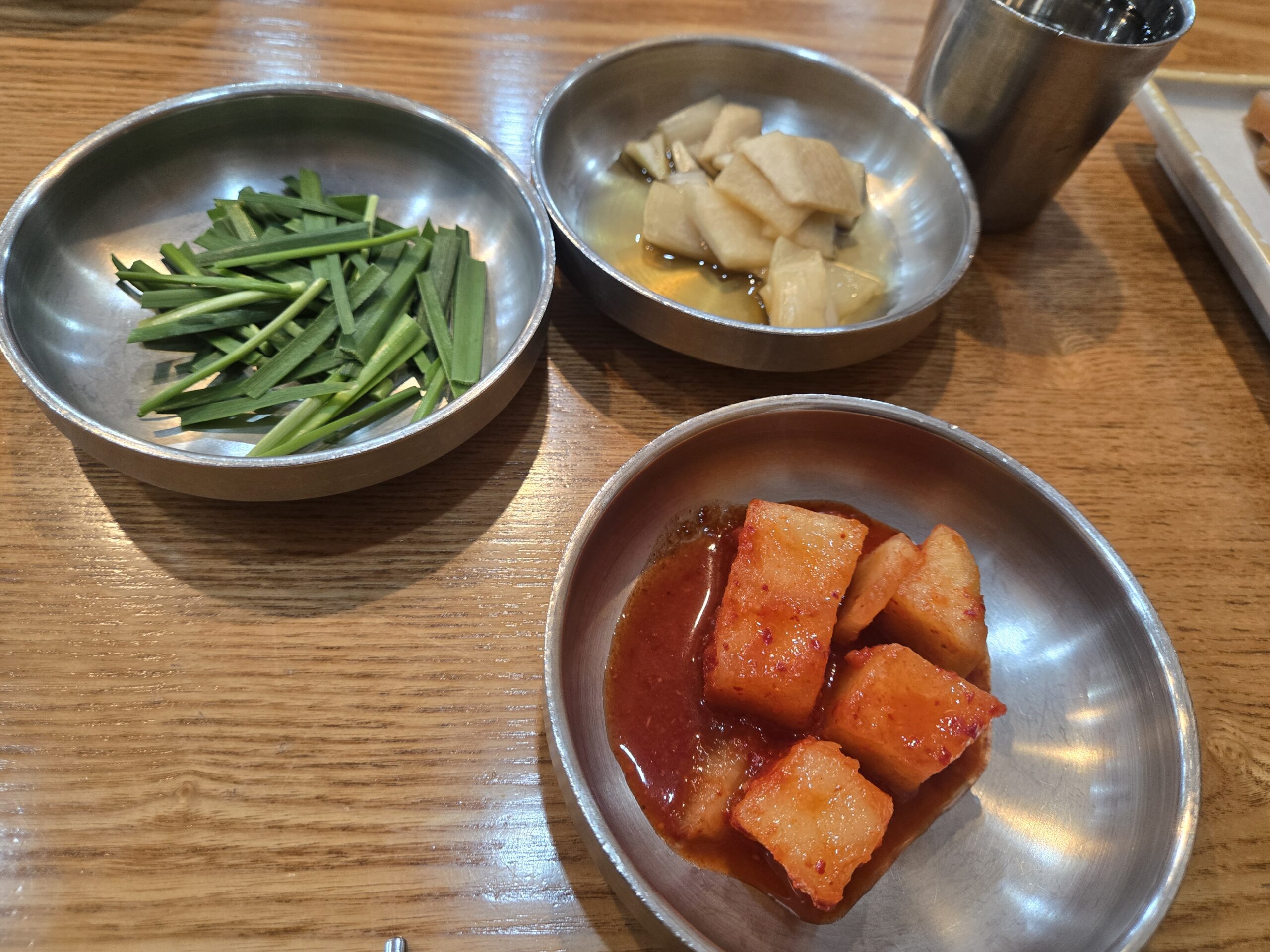
Banchan at Dammion arrives in three small steel bowls. Standard Korean gukbap restaurant lineup: chopped chives in light sauce, pickled radish cubes (depending on the day, sweet or pickled), and a small dish of spicy fermented squash or pickled fruit. Refills are automatic — staff walk by every fifteen minutes and replace any empty bowl without asking.
Chives become essential when eating bossam. You wrap a bossam slice with a few chives and a dab of ssamjang, and the chives cut through the pork richness. Pickled radish cools the spicy gukbap. Spicy pickled side balances the rest. Korean banchan culture isn’t just about side dishes — it’s about a rotation system where each side does specific work in the rhythm of a meal.
For visiting families: don’t skip the chives or the pickled radish. They’re free, they’re refilled automatically, and they’re the actual reason Korean meals feel balanced even when the centerpiece is heavy. If your kids haven’t tried these, this is a good spot to introduce them — Dammion’s chives lean mild, the radish leans sweet rather than sour, and the spicy pickled side can be skipped entirely if it doesn’t suit a child’s palate.
The Part Worth Coming Back For
Most Seongsu restaurants close by 9:30 or 10 p.m. on weekdays — the design and tech crowd that drives the neighborhood tends to wrap office hours by 8 and finish dinner by 9. Dammion stays open later than most, drawing a clientele that includes the late-shift office workers and the post-design-meeting crowds. On a Tuesday at 8 p.m., the restaurant felt close to peak occupancy without feeling hectic.
Tablet ordering helps the after-hours crowd specifically. Late-night office workers are tired and don’t want to flag down servers or wait for menus. Tap, tap, food arrives. Most people at the neighboring tables had ordered a single bowl of gukbap, eaten in twenty minutes, and were leaving as we sat down. Dammion’s design supports that quick-eat rhythm without making it feel rushed.
Korean office workers have specific dinner needs that most restaurants ignore. The food has to be hot enough to feel like a real meal, fast enough to fit in an hour, and substantial enough to not require a snack two hours later. Most Seongsu cafes don’t deliver on the first need. Korean BBQ joints fail on the second. And light-meal spots fail on the third. Dammion solves all three within the same sitting.
The pork-bone broth specifically is what carries the meal — every bowl gets the long-simmer treatment. That depth is what separates Dammion’s gukbap from the rushed versions you find at convenience-adjacent gukbap chains around Korea. The chains can hit speed and price, but they can’t hit broth depth without the multi-hour simmer Dammion clearly puts in.
Daytime Family Use vs Late-Night Office Use
Kid-friendliness is real here too — though not the headline. Earlier in the day, Dammion gets families. Late at night, it’s office workers. Both crowds get the same fast service and the same quality. For visiting families with older kids who can handle Korean restaurant noise and steam, Dammion works for an early dinner around 6 p.m. when the office crowd hasn’t arrived yet. Same dishes I’d ordered tonight, calmer atmosphere.
How Dammion Compares to Other Seongsu Gukbap Spots
Seongsu has been growing into a Korean gukbap hub over the last few years. Three or four spots in the area have become weekday-lunch defaults for office workers in design agencies and tech offices. Compared to those, Dammion sits at the slightly more refined end without losing the casual gukbap-shop feel. Bowls arrive consistently. Broths get the long simmer they need. Pork quality stays above the fast-food gukbap chains.
Two specific contrasts worth flagging. First, Dammion’s eolkun lands hotter than the typical Seongsu spicy gukbap — closer to a 7 out of 10 on Korean spice while most casual spots run at 5 or 6. Second, the bossam at Dammion is a real cold-cut bossam, not a quick-boil version. Some Seongsu gukbap shops add bossam as a token side menu without much care for the slicing or the chilling time. Dammion does it properly.
For a Seongsu food crawl plan, Dammion fits the dinner slot. Earlier in the day, you can hit the Seongsu BBQ tier — places like the Korean BBQ joints we’ve reviewed before. The hot-stew dinner at Dammion balances out the lunchtime grilled-meat focus. The neighborhood layout makes it walkable.
One more practical note. Most Seongsu gukbap restaurants are cash-friendly but not card-optimized. Dammion accepts cards through the tablet without any extra steps, which matters at the end of a long day when you don’t want to deal with split bills the old-fashioned way. The tablet pays the way you’d expect a 2026-era Korean restaurant to handle payment.
Dammion Seongsu Rating Breakdown
Overall: 4.6 / 5
- Eolkun Gukbap (Spicy): 5 / 5 — Bright Korean chili heat over deep pork-bone broth. The 7-out-of-10 spice level lands perfectly for adults who like spicy stews.
- Budae Gukbap Special: 4.5 / 5 — Spam, sausage, ramen, kimchi, tofu. The post-Korean-War nostalgia bowl, executed cleanly.
- Bossam (Pyeonyuk): 4.5 / 5 — Cold-boiled pork belly slices with proper fat marbling. Pairs perfectly with the gukbap.
- Service & Tablet System: 5 / 5 — UPorder tablet, fast food delivery, automatic banchan refills. Designed for the office-worker after-hours crowd.
- Family-Friendliness: 4 / 5 — Earlier hours work for families. Eolkun gukbap is adults-only on the spice. Other options work for older kids.
- Value for Money: 5 / 5 — 11,000 KRW for spicy gukbap, 13,000 for budae(특), 14,000 for large bossam — Seongsu pricing that punches above the price tag.
Practical Info Before You Go
- Address: Seongsu-dong, Seongdong-gu, Seoul (성수동 일대)
- View on Google Maps
- Hours: Roughly 11:00–22:00 (later than most Seongsu restaurants)
- Eolkun Gukbap (얼큰국밥): 11,000 KRW · Budae(특): 13,000 KRW
- Pyeonyuk (편육) Large: 14,000 KRW · Sundae Jeongsik: 16,000 KRW
- Ordering: UPorder tablet at each table. Korean-English toggle available
- Banchan: Chives, pickled radish, spicy pickled fruit. Free refills
- Family-friendly: Yes, especially before 6 p.m. Eolkun is too spicy for younger kids; budae and sundae work fine
- Nearest station: Seongsu Station (Line 2), 5-minute walk
- Parking: Limited street parking nearby. Public transit recommended
Walking Back to the Office Full and Slightly Sweaty
Around 9 p.m. we paid through the tablet, gathered our bags, and walked out. Forehead still warm from the chili sweat. My coworker’s stomach visibly fuller than mine, owing to the bossam he’d kept eating after I’d tapped out. We stopped at a convenience store for water on the walk back, then split — he headed to the subway, I headed back to my office to grab the laptop bag I’d left at my desk.
Walking through the Seongsu commercial strip back toward the office at 9 p.m., I was thinking about how Korean food culture solves problems Western food culture doesn’t. Late-night work hunger has a real solution here. Pizza delivery exists everywhere. Gukbap-with-tablet-ordering is a Korean innovation. Both feed an exhausted office worker, but only one feels restorative.
What I’d Order Again on the Next Visit
Dammion Seongsu earned a permanent slot on my late-night-after-overtime mental shortlist. For Korean office workers in Seongsu running late on a deadline, the fast tablet ordering, the late hours, and the eolkun gukbap make it the right call. Not every spicy gukbap stays interesting after the first ten bites. Dammion’s does. The pork-bone depth carries the heat across the whole bowl, and by the time you’re done, the broth has done as much work as the toppings.
For visiting families or for adult solo travelers in Seongsu looking for an authentic Korean gukbap experience without venturing into Gwangjang Market crowds, Dammion is one of the safer picks. Pair it with a Seongsu walk past Seokam Seongsu for stone-grilled pork belly later in the trip, or with the Mongttang Saenggogi BBQ spot we reviewed earlier. Three Seongsu stops, three different Korean food angles. Dammion fills the gukbap slot reliably.
The eolkun gukbap is the order I’d repeat next time. My coworker said the same about the budae. We agreed to make this a monthly Seongsu late-night routine — work hours permitting. Hopefully the deadlines don’t get any tighter, or we’ll be back at Dammion sooner than that.