
- Name: 향기수산 (Hyanggi Susan), a seafood stall at Garak Mall, Garak Market
- Location: Garak Mall raw fish center, sales building (가락몰 회센터 판매동), 1F, stall C-1, Garak Market, Songpa-gu, Seoul · Google Maps (Garak Market)
- Nearest station: Garak Market Station (Lines 3 and 8); Visit Seoul puts Garak Mall 147 m from exit 2
- Visited: winter, early 2026
- What we bought: fatty yellowtail sashimi (dwaeji bangeo hoe), small, 85,000 won as far as I remember, to take home
- My rating: 4.7 / 5
- Info checked: September 23, 2026
Garak Market (가락시장) in Songpa-gu is one of Seoul’s big wholesale markets, and its seafood building is full of stalls selling live fish and sliced raw fish. Early this year, in winter, I went to a stall there called Hyanggi Susan (향기수산) and bought a small platter of fatty yellowtail sashimi to take home. It had been a while since I’d had hoe (회, raw fish), and it was excellent: the yellowtail had a sweet taste that I still remember.
About Garak Market
Garak Market opened on June 19, 1985, according to Seoul city. According to the Songpa-gu district office, the seafood market has 206 stores, and the wholesale market runs 24 hours a day, all year. That is the market as a whole, not every shop in it: I didn’t check Hyanggi Susan’s own opening hours, so don’t assume a single stall is open at any hour. Seafood comes in between 9 p.m. and 3 a.m., and the auctions start at 1 a.m. The same page notes that you can buy seafood at the market and have it prepared to eat at restaurants inside the market.
The nearest subway stop is Garak Market Station. The district office page gives exit 3 of the Line 8 station for the market as a whole.
Dwaeji bangeo, big yellowtail
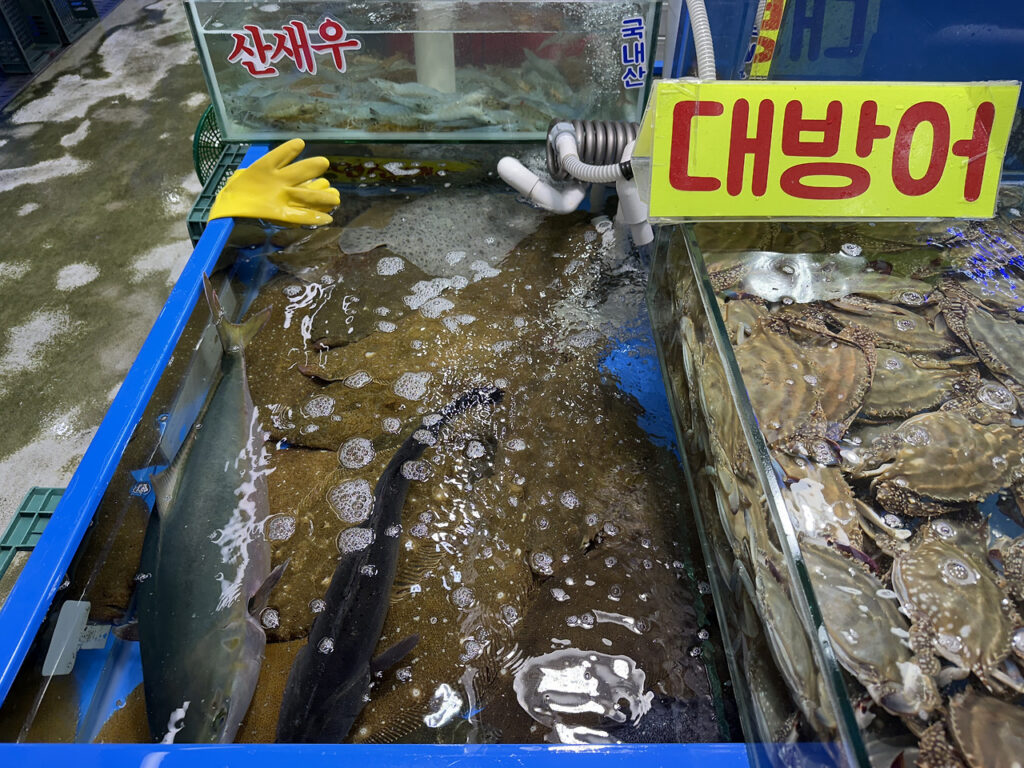
Bangeo (방어) is yellowtail, and the biggest ones are sold as dae-bangeo (대방어, “big yellowtail”). “Dwaeji bangeo” (돼지방어), which you will see on some menus, uses the word for pig, dwaeji, to describe a big, fat fish. At the stall there was a tank with a large “대방어” sign.
What came in the box
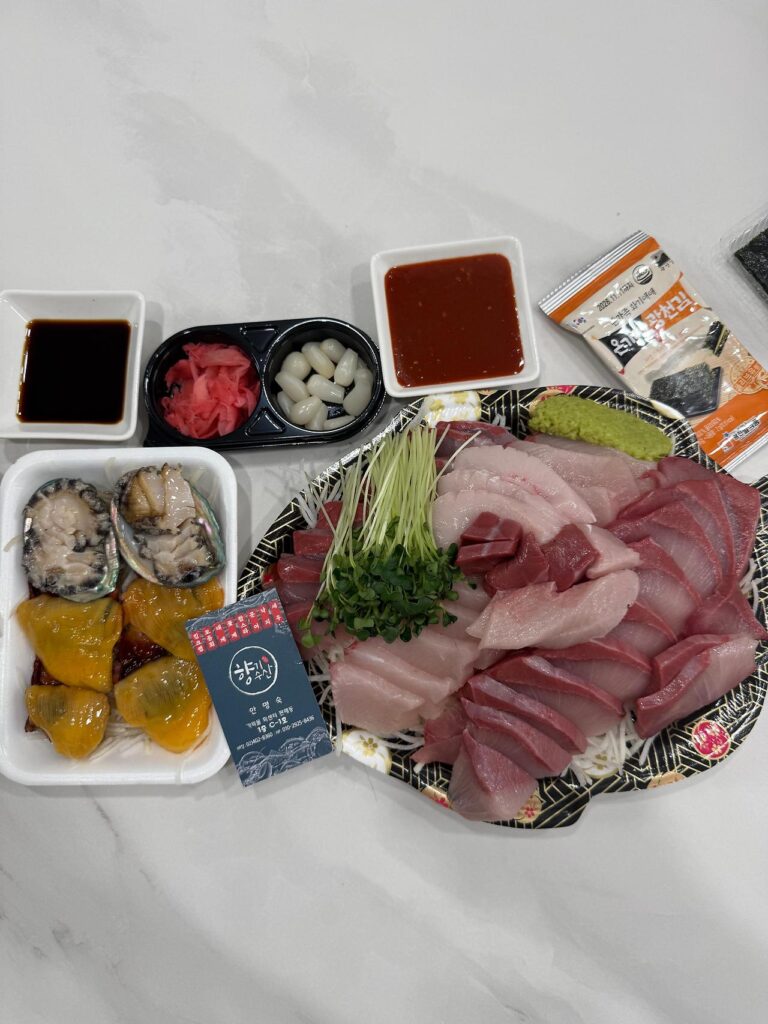
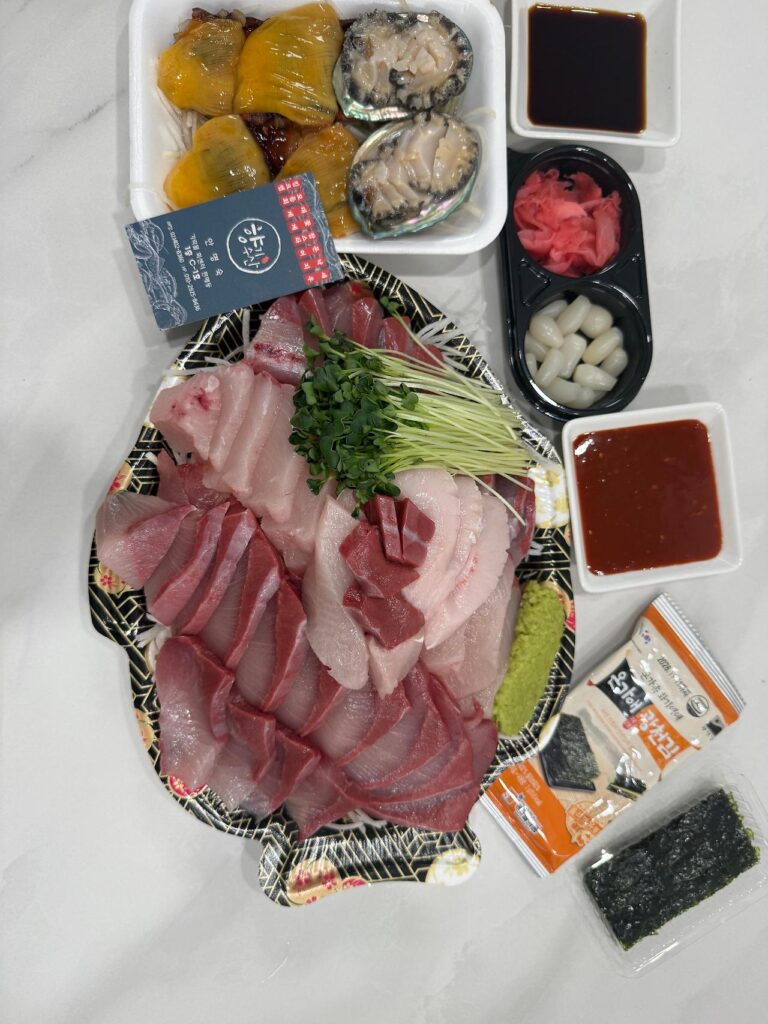
We had it packed to take home. The small platter was for three of us: my wife, me, and one of our kids who eats raw fish. Our other child doesn’t eat raw fish. The platter had thick slices of yellowtail in different cuts, from pale pink to deep red, with a bunch of greens in the middle, on a round tray with a black and white pattern. The stall’s dark blue card was tucked in next to the fish. Packed around it were:
- soy sauce and wasabi
- chojang (초장), a sweet and sour chili sauce that Koreans often eat with raw fish
- pickled ginger and pickled garlic
- packets of seasoned seaweed (gim) for wrapping
- a small box with abalone and sea squirt (meongge, 멍게)
How it was
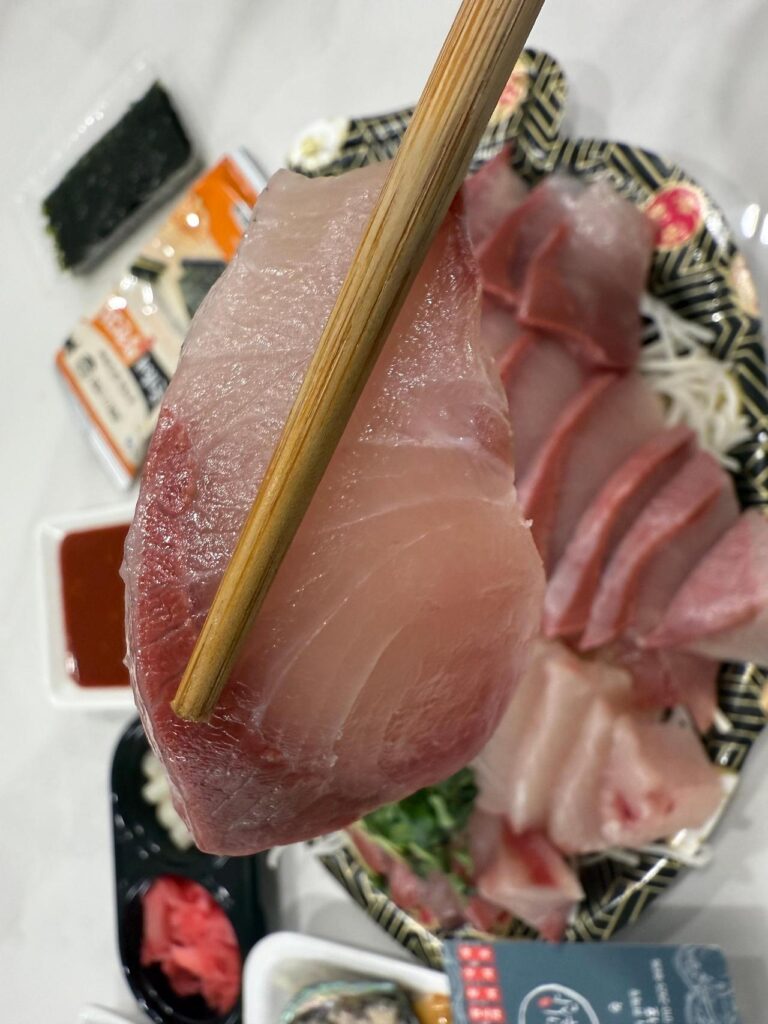
It was very good. The slices were thick, and the yellowtail had a clear, sweet taste. It had been a long time since I’d eaten raw fish, which may be part of why I enjoyed it so much. The box came with two dipping sauces, soy sauce with wasabi and chojang, and I used both.
Taking it home or eating it there
We took ours home, and everything was packed so that it could be carried: the platter on a tray under wrap, and the sauces and sides in their own containers. We didn’t eat at the market on this visit.
Eating at the market instead
If you would rather eat your fish at the market, the Visit Seoul guide to Garak Market describes how it works at Garak Mall, the market building that opened in 2016 and where Hyanggi Susan is. Seafood is sold on the first floor, where the guide counts about 100 shops. You buy there and take your seafood to the restaurants upstairs, which will cook it for you by steaming, grilling or in a spicy stew, for a fee. The guide gives examples such as 7,000 won per kilogram for steaming and 10,000 won per kilogram for grilling, and 10,000 won and up for a spicy stew for two.
The same guide lists opening hours for Garak Mall: the general stores from 8:00 to 20:00, and the restaurants from 11:00 to 23:00. It puts the entrance 147 m from exit 2 of Garak Market Station (Lines 3 and 8).
Finding the stall
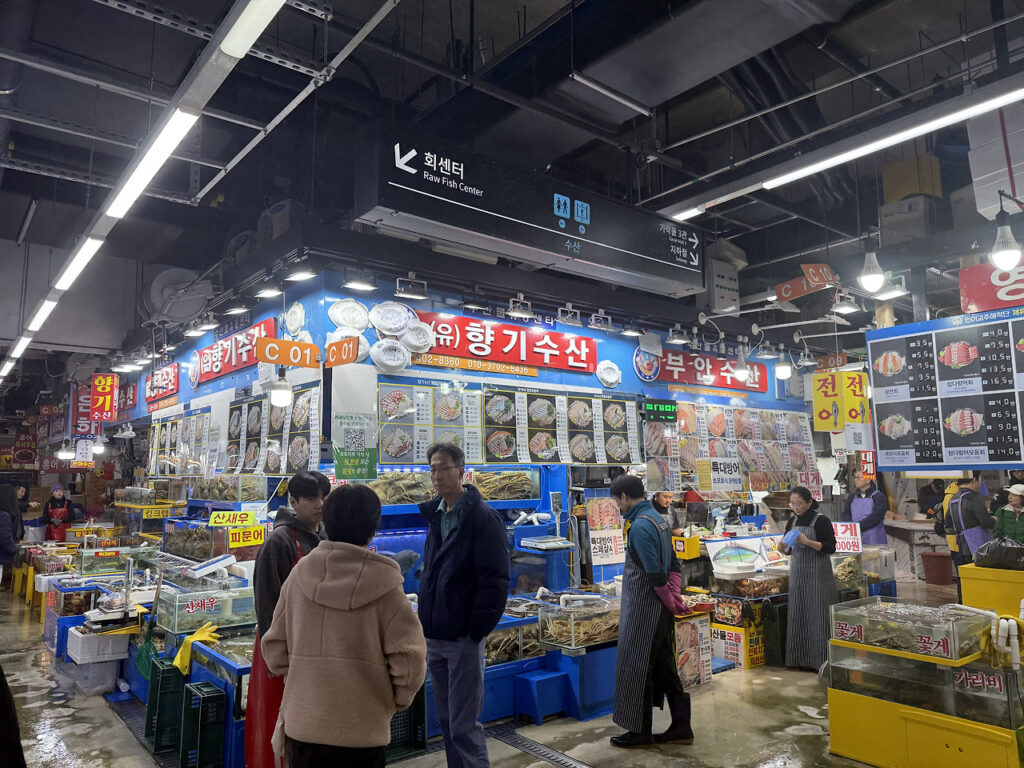
Hyanggi Susan’s business card gives its location as the raw fish center of Garak Mall, sales building (가락몰 회센터 판매동), first floor, stall C-1. The hall is full of stalls with tanks out front, and each stall has a code like this, so the number is the easiest way to find it again. The card also lists what the stall sells: king crab, assorted sashimi, snow crab, blue crab, lobster, octopus, small octopus and shrimp. Around the stall there were tanks labeled 대방어 (big yellowtail), 산새우 (live shrimp) and 돌멍게 (stone sea squirt), and trays of oysters on ice.
Korean words that help at a fish market
The signs and tanks at the stalls we saw were labeled in Korean. These words cover what we saw and bought, with their pronunciation.
| Korean | Say it | Meaning |
|---|---|---|
| 회 | hoe | raw fish, sliced |
| 방어 / 대방어 | bangeo / dae-bangeo | yellowtail / big yellowtail |
| 광어 | gwangeo | flatfish (olive flounder) |
| 우럭 | ureok | rockfish |
| 연어 | yeoneo | salmon |
| 멍게 | meongge | sea squirt |
| 전복 | jeonbok | abalone |
| 초장 | chojang | sweet and sour chili sauce for raw fish |
| 킹크랩 / 대게 | king keuraep / daege | king crab / snow crab |
| 꽃게 | kkotge | blue crab |
| 산새우 | san saeu | live shrimp |
| 모둠회 | modum hoe | assorted sashimi |
| 포장 | pojang | to take away |
| 소 / 중 / 대 | so / jung / dae | small / medium / large |
We ordered the small size (so) and had it packed to take away (pojang).
Other raw fish and seafood on the blog
- Jeong Chamchi in Seongsu, a tuna course dinner
- Sushi Ian Wirye, 1,990 won conveyor belt sushi
- Jjimagi Bangi, steamed clams in Songpa
- Jeju Dongmun night market, including sashimi packs to take away
If you are in Seoul in winter and like raw fish, a yellowtail platter from Garak Market is worth the trip. I’d go back to Hyanggi Susan for the same thing.