
After a full day on the slopes at Oak Valley, none of us wanted another dinner inside the resort, so we drove a few minutes down Wolsongseokhwa-ro and turned in under a blue-lit sign that read 들꽃가든. Deulkkot means wildflower, and the restaurant behind the sign is a big Korean dining room in Jijeong-myeon, Wonju, with pork belly for the table grill, set meals and a long list of soups and stews. The four of us, my wife, our two kids and me, shared a jeyuk bokkeum set, a galbitang and a doenjang stew. The jeyuk was the ordinary kind, the galbitang was decent, and the bright yellow turmeric rice is the part of that evening we still bring up.
- Name: 들꽃가든 (Deulkkot Garden), Wonju
- Address: 488 Wolsongseokhwa-ro, Jijeong-myeon, Wonju-si, Gangwon-do (강원 원주시 지정면 월송석화로 488, from the poster in the restaurant) · Google Maps
- Hours: 05:30 to 21:30 (poster in the restaurant; check before you go)
- Visited: dinner after skiing, winter 2026, the four of us (my wife, our two kids and me)
- What we ordered: one jeyuk bokkeum set (17,000 won), one galbitang (17,000 won) and one doenjang stew
- Total from the board prices: 17,000 + 17,000 = 34,000 won for the set and the galbitang, plus the doenjang stew, whose price for a meal without grilled meat is not on the board (see the section on what dinner came to)
- How the four of us scored this dinner: 3.8 out of 5, pulled up by the turmeric rice
- Info checked: October 21, 2026

Pulling in off the resort road
It was already dark by the time we had returned the ski gear, changed and got everyone into the car. Wolsongseokhwa-ro is the road you take toward Oak Valley Resort, and in the evening the places along it are mostly lit signs and parking lots. This one caught my eye because the sign glows blue, which is the photo above. I took it standing in the lot while my wife got the kids out of the back seat. There was plenty of room to park, and that turned out to make sense once I read the poster inside.
The dining room is large and bright, with rows of wooden tables. Every table has a grill set into the middle and a metal extractor pipe hanging over it, the same setup you find in most Korean barbecue restaurants. We had decided in the car that nobody had the energy to stand over a grill, so ours stayed cold all evening and we used the space around it for plates. The kids took the seats facing the wall, mainly so they could look at the big poster while we sorted out what to eat.
What the poster on the wall says
That poster is the restaurant introducing itself, and it is worth reading before you order. It ranks the best-selling dishes in order. Ogyeopsal comes first, pork belly with the skin left on. After it come the ssambap set and the jeyuk set, then the perilla and cabbage doenjang soup, then a spicy seafood soft tofu stew. Lower down it says there is parking for 4 buses and 30 cars and that groups can be picked up. It also lists driving times from the door: 5 minutes to Oak Valley, 7 minutes to Oak Hills and about 10 minutes to the Ganhyeon resort area.
Near the bottom, the poster pushes the turmeric rice (강황공기밥) as the healthy choice. At that point we had no idea what it would look like. The bus parking and the group pick-up line explain the size of the lot outside. A place on the resort road with room for coaches is clearly set up for ski groups and tour parties as well as families like us who just drive in.
The menu board and its prices
The board on the wall is split into three blocks: grilled meat, lunch specials and simple meals. I copied the table below from my photo of the board, so every number is what was written there on our winter evening. Prices like these can move, so treat them as a guide:
| Dish | Korean | Price (won) |
|---|---|---|
| Ogyeopsal, Korean pork, 200 g per person | 오겹살 | 22,000 |
| Doenjang stew / scorched rice / steamed egg (with meat) | 된장찌개 / 누룽지 / 계란찜 | 5,000 each |
| Ssambap set with river snails (wraps with rice) | 우렁쌈밥정식 | 18,000 |
| Jeyuk bokkeum set | 제육볶음정식 | 17,000 |
| Perilla doenjang cabbage soup with snails | 들깨우렁된장배추국 | 10,000 |
| Clam and cabbage soup | 바지락백합배추국 | 12,000 |
| Spicy seafood soft tofu stew | 해물짬뽕순두부 | 15,000 |
| Galbitang (short rib soup) | 갈비탕 | 17,000 |
| Ttuk-bulgogi, beef bulgogi with broth in a hot clay pot | 뚝불고기 | 13,000 |
| Beef head soup with rice | 소머리국밥 | 13,000 |
| Kimchi stew | 김치찌개 | 10,000 |
| Pine nut makguksu (cold, spicy or large) | 잣막국수 | 10,000 / 13,000 |
| Buckwheat crepe roll | 메밀전병 | 10,000 |
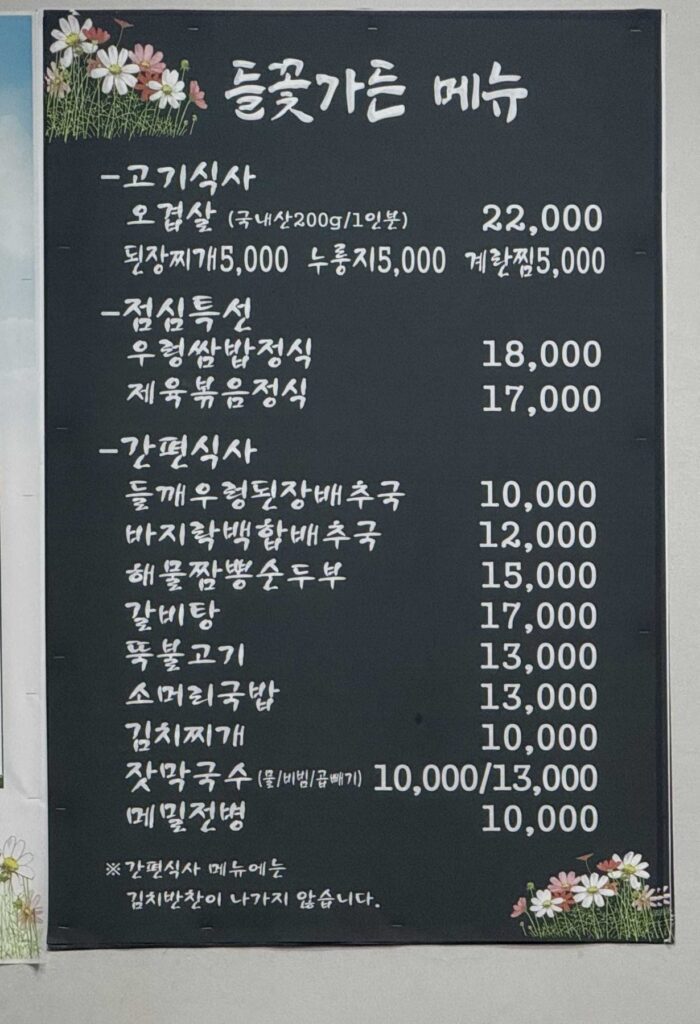
A note at the bottom of the board reads “간편식사 메뉴에는 김치반찬이 나가지 않습니다”, which says that kimchi is not served with the simple meals (the soups, stews, noodles and buckwheat crepe priced from 10,000 to 17,000 won). The note mentions only kimchi, and since we ordered a set meal, I did not see what else comes with a simple meal. The pine nut makguksu is 10,000 won in cold broth or spicy, and 13,000 won as a large portion (곱빼기). A handwritten card next to the poster also offered hanwoo sirloin (1++ grade, 150 g) for 40,000 won. The jeyuk bokkeum set and the ssambap set are listed as lunch specials, but we were able to order the jeyuk set at dinner.
How we settled on three dishes
Ordering took us longer than it should have. The ogyeopsal tops the poster, and I was tempted, but with tired kids and wet hair the idea of cutting pork with scissors over a hot grill lost quickly. My wife wanted something with a hot broth after the cold on the slopes, and galbitang was the obvious pick. I wanted the jeyuk set because it comes with leaves for wrapping and a spread of side dishes, and I was not sure it would be available, since it sits under the lunch heading. The server said it was fine. The kids asked for doenjang stew, which they eat at home with rice and know they like.
Three dishes for four people sounds thin, and I did wonder about it while we waited. In the end it was enough. The set came with so many small plates that the table filled up, and nobody went back to the board for more.
The side dishes and the wrap basket
The jeyuk set came with a spread of small side dishes: seasoned vegetables, braised eggplant, kimchi, a salad of shredded vegetables, and a basket of lettuce and cabbage leaves for wraps. Each of us got a bowl of the yellow turmeric rice.

The photo above is the table a minute after the plates landed, before anyone had touched them. The braised eggplant went first. It is soft and a little sweet, and our younger one, who usually leaves vegetables to the end, kept reaching across for it. The shredded vegetable salad was cold and sharp, a good thing to eat between bites of pork. The kimchi was the regular cabbage kind. Because we had ordered a set, it came to the table, which matters given the note about simple meals on the board.

The leaf basket held two kinds: soft lettuce, and paler cabbage leaves that are firmer and crunch when you bite. I like doubling them, a cabbage leaf underneath for strength and lettuce on top. The kids preferred lettuce alone because it folds more easily in small hands.
Jeyuk bokkeum
Jeyuk bokkeum (제육볶음) is thin-sliced pork stir-fried in a spicy red sauce with onion. Ours came on a wide white plate with sesame seeds scattered over it. It was a basic version, close to what you would get at most Korean restaurants, with nothing in the sauce or the cut of the pork that set it apart. That is not a complaint. After skiing, a familiar plate of saucy pork was what I wanted.

We ate most of it as wraps. If you have not made one before, lay a leaf flat on your palm, add a small spoon of rice, then a piece or two of pork, and fold it into one mouthful. The yellow rice made the wraps look different from any we had made before, which the kids found funny. The photo below is one of mine just before it went in.

Galbitang and doenjang stew
The galbitang (갈비탕) arrived in an earthenware pot, still steaming. It is a clear beef broth, and ours had short rib pieces on the bone, glass noodles, green onion and a single jujube floating on top. My wife had first claim on it, and she called it decent, which matches what I tasted when I got a spoonful. The broth was light and clean, and the rib meat came off the bone without much work. The glass noodles disappeared fast once the kids noticed them.

The doenjang stew (된장찌개) was the kids’ dish. It had cubes of tofu and vegetables in a brown soybean paste broth, the kind of stew Korean families eat at home several times a week. They spooned it over their yellow rice and ate it that way, alternating with lettuce wraps of the pork when the stew got too hot to hold.

The turmeric rice
The rice is what we remember from Deulkkot Garden. Instead of white rice, every bowl came out bright yellow, cooked with turmeric, the same rice the wall poster sells as the healthy option. When the lids came off, our older one asked if it was egg fried rice. I think it was the first time I had eaten yellow rice like this. It tasted slightly sweet, with no strong spice, and it went well with both the salty doenjang stew and the red jeyuk sauce. Nobody left any in their bowl.

What the dinner came to
I no longer have the slip from that night, so the numbers below come from my photo of the board. Two of our three dishes have a clear price there. The doenjang stew does not: the only stew price on the board is 5,000 won, and it sits in the grilled meat block with the words “with meat”, meaning it is the add-on for tables that order ogyeopsal. We did not grill anything, so I cannot say what our stew cost, and I have left it out of the sum rather than guess.
| Dish | Qty | Board price (won) |
|---|---|---|
| Jeyuk bokkeum set (제육볶음정식) | 1 | 17,000 |
| Galbitang (갈비탕) | 1 | 17,000 |
| Subtotal of the two priced dishes | 34,000 | |
| Doenjang stew (된장찌개), our order without meat | 1 | not on the board |
So the part I can put a number on is 17,000 + 17,000 = 34,000 won, and our real bill was that plus whatever the stew was charged at. If you want a firm figure before you go, ask at the counter how the stew is priced when you are not having meat.
The 5,000 won stew price does apply cleanly to a table that grills. As an example only, and not what we ate: two portions of ogyeopsal with one doenjang stew added would be 2 x 22,000 + 5,000 = 49,000 won on the board. Had all four of us gone for the pork at the top of the poster, the meat alone would have been 4 x 22,000 = 88,000 won before any stew or rice. Next to those figures, the set and the soup we chose kept our dinner at the lower end of the board, which was welcome on a ski trip where lift passes and rentals had already eaten into the budget.
Reading the menu
- 정식 (jeongsik): a set meal, served with rice and side dishes. Our jeyuk set came with kimchi and several side dishes.
- 쌈밥 (ssambap): rice eaten wrapped in leaves; 우렁 (ureong) are river snails, cooked into the dipping paste.
- 배추국 (baechuguk): a light cabbage soup; 들깨 (deulkkae) means perilla seed.
- 뚝불고기 (ttuk-bulgogi): bulgogi served in a hot earthenware pot with broth.
- 메밀전병 (memil jeonbyeong): a thin buckwheat crepe rolled around a filling, a common Gangwon-do dish.
Tips if you are staying at Oak Valley
- Timing: the poster gives the hours as 05:30 to 21:30. That early start means it could work for a hot breakfast before the lifts open, though we only went for dinner. Check the hours before you drive over.
- Kimchi: if you order one of the simple meals, such as the galbitang or a noodle dish on its own, the board says kimchi does not come with it. Pair it with a set if kimchi matters to you.
- Lunch sets at dinner: the jeyuk set is under the lunch heading, and we could still order it in the evening. Ask if the one you want is the same.
- Cold noodles: the pine nut makguksu has a large size (곱빼기) for 13,000 won, handy if someone in your group is very hungry after skiing.
- With kids: the doenjang stew and the turmeric rice were what ours ate most of. Neither is spicy.
What we thought
It was a fair dinner and an easy one. I would not drive out from Wonju city just to eat here: the jeyuk was standard and the galbitang was decent. The turmeric rice gave the meal something of its own, the side dishes covered the table, and it is only a few minutes from the resort, and we parked easily that night. For a simple Korean dinner on a ski trip, it did what we needed, and I give it 3.8 out of 5.
Finding it
The address is 488 Wolsongseokhwa-ro in Jijeong-myeon, on the same road you use to reach Oak Valley. The poster puts it 5 minutes by car from the resort and gives the parking as room for 4 buses and 30 cars. On our winter evening we pulled straight into a free spot near the door, though I cannot say how full the lot gets when a tour group arrives. Look for the blue sign on your way back from the slopes.
Other places we ate at or stopped by during this ski trip:
- Oak Valley Resort breakfast buffet, where we started three of our mornings, at Forest in Tower C
- Mannajeong, pork belly and grilled mackerel on another evening of the trip
- Ganhyeon Bakery, where we stopped for salt bread in Jijeong-myeon