Dalnimine Seongsu Lunch: Spam Fry and Jeyuk Bokkeum Review

Dalnimine Seongsu is the kind of office-block lunch spot you only find by accident. A coworker pulled me into a glass-front door I’d walked past a dozen times. Twenty minutes later I was staring at six thick spam slices stacked over two sunny-side eggs. My older colleague waved his chopsticks at a separate jeyuk bokkeum plate sitting between us. Total bill for two adults — spam fry, jeyuk bokkeum, two rice bowls, four side dishes — came to 27,000 KRW. That math is why I’m writing this post a week later. Below is exactly what we ate, what it cost, and why every Seongsu desk worker should keep this address bookmarked.

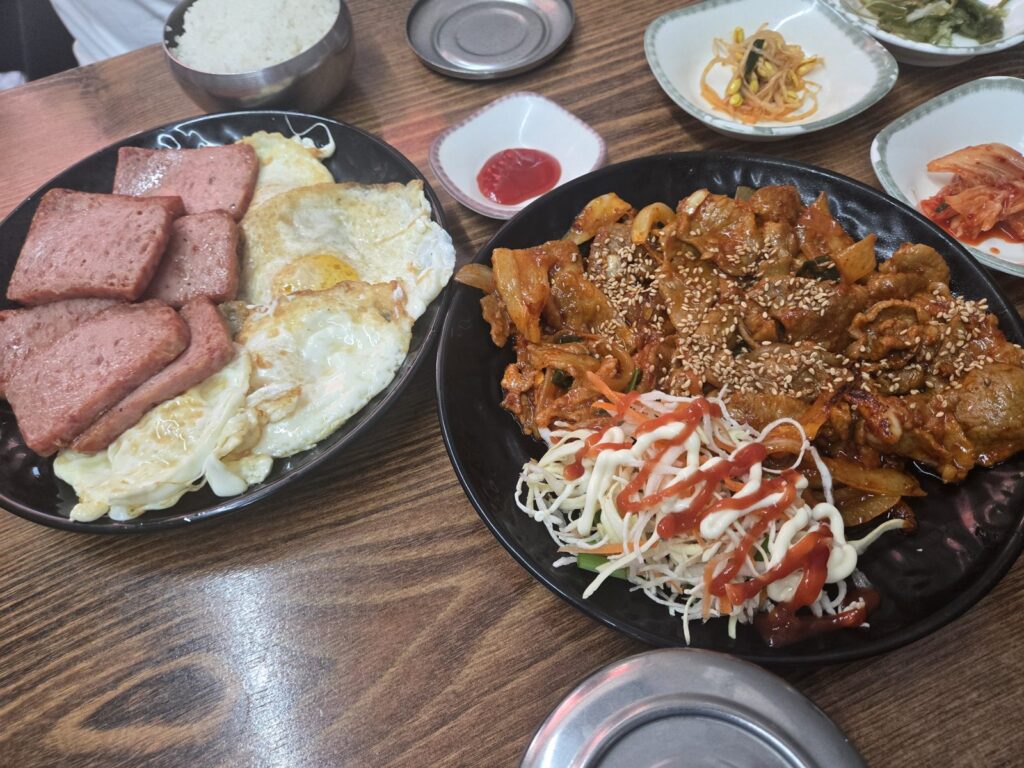
Dalnimine Seongsu spam fry and jeyuk bokkeum lunch plates
Dalnimine Seongsu — spam fry plate and jeyuk bokkeum on the same wooden table.

Why a Coworker Dragged Me to Dalnimine Seongsu

My team had a rotating lunch problem. We were burning through the same chicken chains and convenience-store kimbap week after week. So when a senior dev sat down beside me on Tuesday and said, “I found a place. Old-school. Just trust me,” I went. We walked four blocks east of Seongsu Station, past a dry cleaner, a print shop, and one shuttered bike rack.

For my team, lunch decisions had become a daily mini-negotiation. Three of us wanted Korean food. Two wanted the convenience store. And the senior dev wanted whatever was cheapest. Plus he claimed to know “a place that solves all three.” So we went.

Also, the spot has no English signage, no Instagram presence, and no waiting line at 12:30 p.m. on a weekday. For an area that’s gotten increasingly hipster-cafe in the last three years, that contrast is rare. And the prices on the wall confirmed we’d stepped sideways into a different era of Seoul lunch culture. Eight thousand won for white rice and side dishes. Eleven thousand for a full jeyuk bokkeum plate.

A Side Alley Just Off the Seongsu Office Block

Dalnimine sits about a six-minute walk from Seongsu Station Exit 2. Once you cross the main street, hook left at the convenience store, and keep going until you see a row of two-story brick buildings on your right. The shop is on the ground floor, glass front, with a vinyl sign in plain Korean that just says 달님이네 — “Dalnim’s Place,” literally.

For first-timers, the entrance is easy to miss. But if you spot a small handwritten A4-sheet menu taped to the door listing 백반 / 제육볶음 / 낙지볶음, you’re at the right spot. The address is in Seongsu-dong 1-ga, and the area Google maps it as the print-shop district — which fits, because most lunchtime customers are office workers in untucked dress shirts. For Korean BBQ in the same neighborhood, our Seokam Saengsogeum-gui Seongsu review covers the stone-grilled pork belly route.

Plus, the building is quiet on the outside. No music spilling out. No LED sign. No neon. So you’d never guess that inside, six tables are full and an ajumma is plating four orders simultaneously while the noon news runs on a TV mounted above the kitchen pass-through.

And on the way over, the senior dev pointed out three other shops we’d never noticed — a 칼국수 spot, a 백반 cafeteria, and a small Chinese-Korean joint. So this stretch of Seongsu is technically Office Lunch Row for the local print and design firms, despite being only ten minutes from the cafe district.

Stepping Inside: A Wall of Food Photos and a Quiet Van Gogh

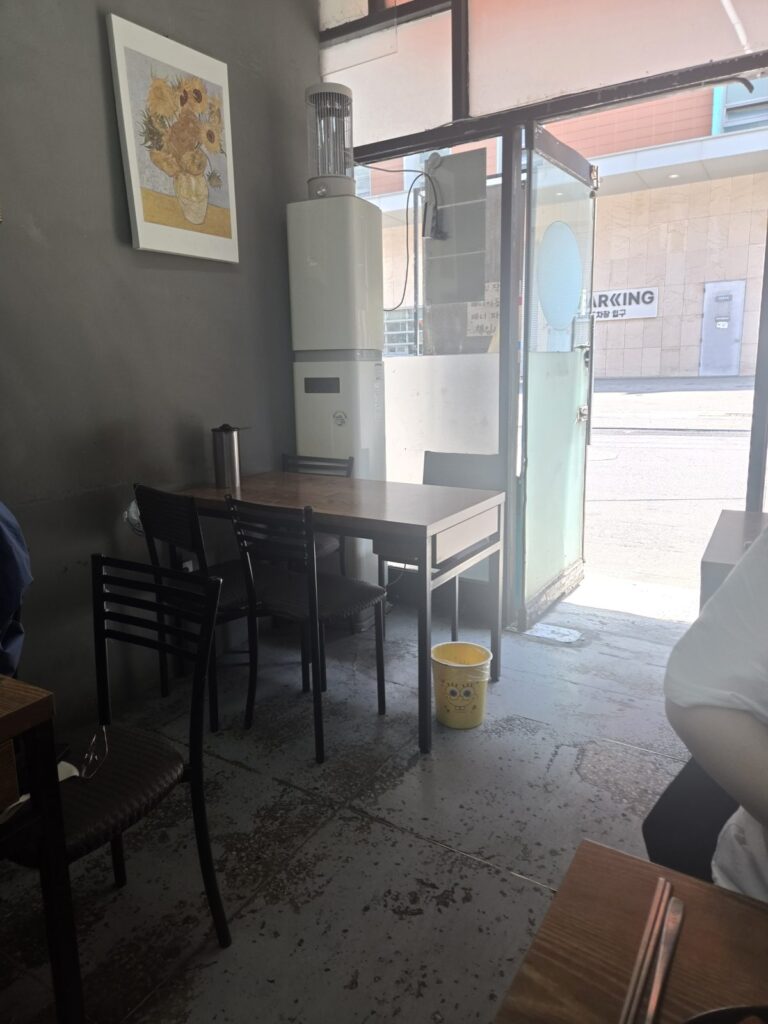
Dalnimine Seongsu interior wall with food gallery photos
Wall gallery at Dalnimine Seongsu — printed photos of every menu item and a 콩국수 banner.

Inside, the space reads like an early-2000s family diner. A row of square wooden tables runs along the left wall. Each table has a stainless-steel canister for banchan lids, a paper napkin holder, and two mismatched chairs.

On the right wall, the owner has taped up nine printed food photos in a horizontal line. They’re not professional shots — clearly camera-roll photos blown up to letter size and slid into cheap clear frames. Each one shows a different menu item: the 제육볶음, 낙지볶음, 떡볶이, 스팸&후라이, even the 콩국수 with a hand-lettered banner beside it announcing summer’s signature cold-noodle soup.

And on the back wall, slightly off-center, hangs a print of Van Gogh’s Sunflowers. So that’s the surprise. The only non-food decoration in the room is a museum-shop reproduction. It’s a copy of one of the most-photographed paintings of the 19th century, hanging quietly behind table six.

Also, two box-style aircons are mounted high on either side of the kitchen pass-through. Both were running on full at noon, which is the only way to make this much spam frying tolerable on a 24-degree May day. Above them, the TV plays MBN news on mute.

The Dalnimine Seongsu Menu Board Reads Like a Korean Mom’s Kitchen

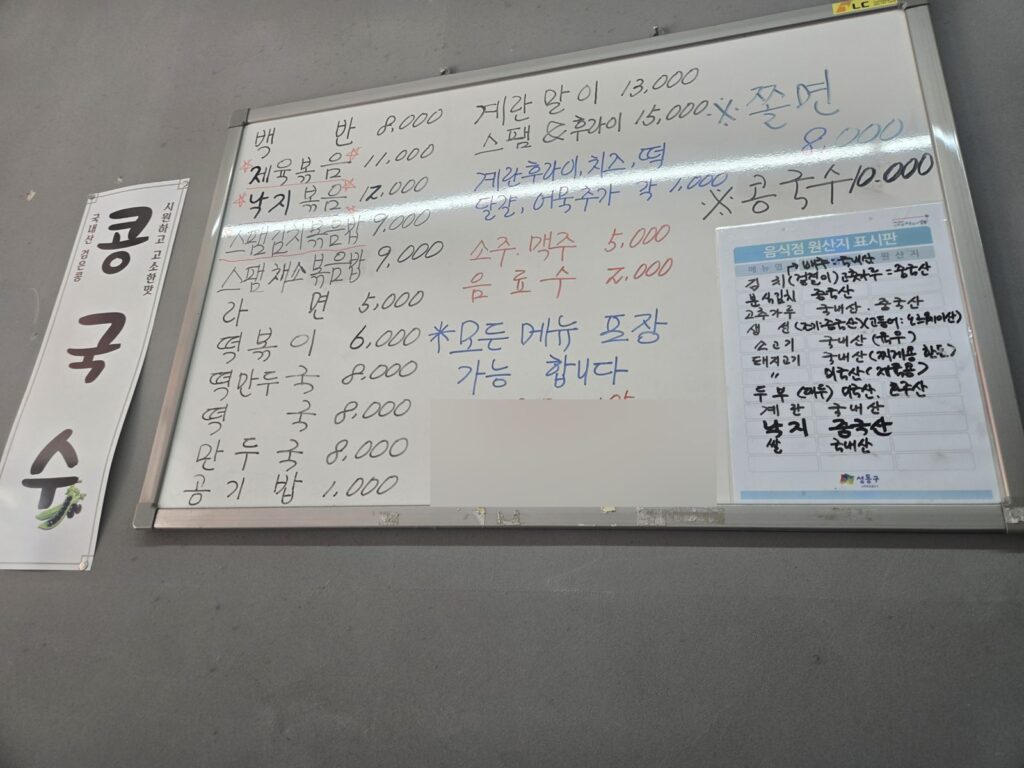
Dalnimine Seongsu menu board with prices in Korean
Handwritten menu board at Dalnimine Seongsu — every price under 15,000 KRW.

The price board hangs to the right of the kitchen, written in three colors of dry-erase marker. So the layout is half black text (mains) and half blue text (premium items), with a few entries crossed out in red — items that are off the menu today.

For the mains, the cheapest is 백반 (baekban, plain set meal) at 8,000 KRW. Then 제육볶음 (jeyuk bokkeum) at 11,000. Next 낙지볶음 (naktji bokkeum, stir-fried baby octopus) at 12,000. Both spam-and-something rice bowls — 스팸김치볶음밥 and 스팸채소볶음밥 — sit at 9,000. And at the bottom: 라면 5,000, 떡볶이 6,000, plain rice 1,000.

In the blue column, two splurges: 계란말이 (giant rolled omelet) at 13,000 and 스팸&후라이 — the spam fry plate I ordered — at 15,000. Plus add-ons: extra fried egg, cheese, rice cake, pickled radish, or fish cake at 1,000 each. And in red: 쫄면 8,000, with a separate 콩국수 announcement at 10,000 KRW for summer.

For drinks, soju and beer are both 5,000 KRW, soft drinks 2,000. Phone orders are accepted at 010-9354-9065 — “all menu items available for takeout” is hand-printed at the bottom in red, which I imagine the office across the street uses heavily.

Spam Fry Plate (15,000 KRW): Six Slices, Two Eggs, No Pretense

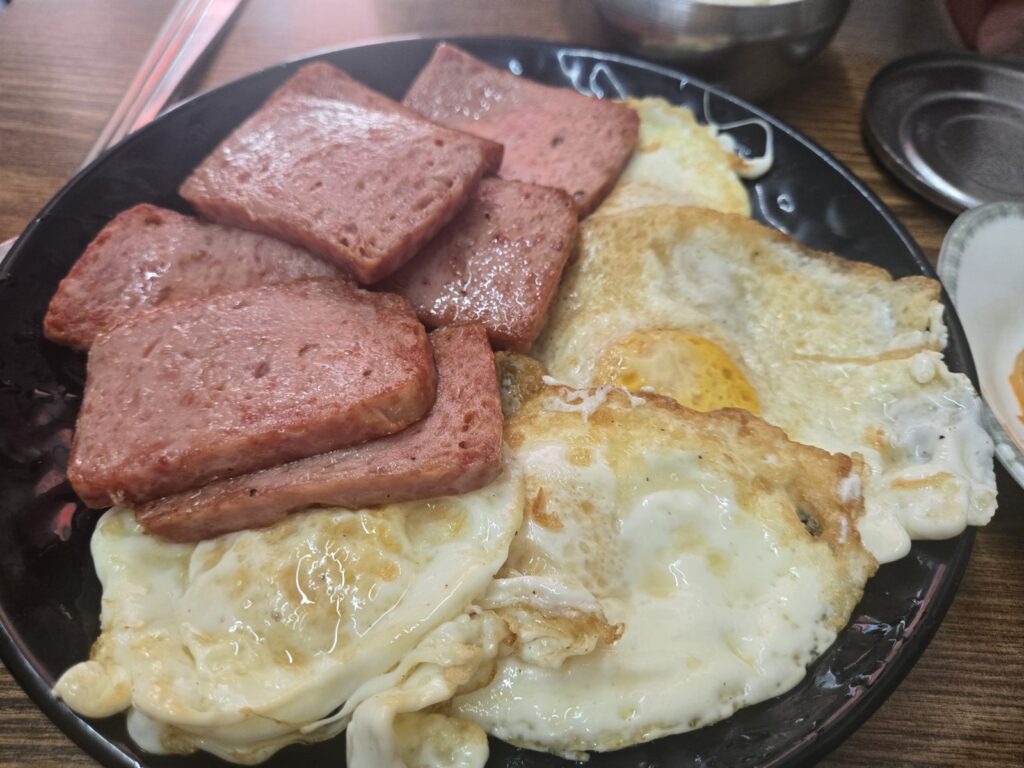
Dalnimine Seongsu spam fry plate close-up with sunny eggs
Spam fry plate at Dalnimine Seongsu — six thick spam slices over two sunny-side eggs.

My senior colleague pushed me toward the 스팸&후라이 (Spam & Fry) plate on the first visit. So at 15,000 KRW, it’s the second-most-expensive item on the board — only the rolled omelet beats it. And for that price, what you get is essentially the savory comfort food of half of Korea’s military generation, plated for two.

Six slices of fully cooked Spam — and yes, the actual Hormel-licensed Korean Spam, not generic luncheon meat — arrive shingled across one half of a heavy black ceramic plate. Each slice is roughly a quarter-inch thick. Both faces are seared to a deep mahogany. The fat has crisped at the edges, and the juices have pooled slightly under the stack, picking up a faint sheen of the oil the eggs were cooked in.

On the other half of the plate sit two sunny-side eggs, served crispy at the edges with the yolks still glossy. So the whites are lacy — clearly cooked at a much higher pan temperature than you’d ever do at home — and the runny yolks stay intact when you tilt the plate.

For non-Koreans reading this, Spam in Korea isn’t a joke ingredient. The Hormel product was brought in by the U.S. military post-Korean War, and within a generation it became a cornerstone of Korean comfort cooking — sliced into stews, fried for school lunchboxes, gifted in elaborate Chuseok holiday sets. To this day, premium Spam gift sets outsell wine baskets at major Korean grocery chains. Plus, at 15,000 KRW for six slices and two eggs, the dish is a love letter. The era it nods to: one tin of Spam was enough to make a family meal feel special.

Why the Eggs Mattered More Than I Expected

Most spam-and-egg plates I’ve eaten in Seoul use sunny-side eggs as garnish — single, undersized, often overcooked. Dalnimine plates two full eggs. So they cover almost half the dish, and they’re sized for sharing rather than as a single garnish.

The yolks were the real surprise. At a place serving 8,000-won baekban, I’d assumed the eggs would be a budget afterthought. Instead, they were cooked exactly the way I cook eggs at home for my kids. The recipe is high heat plus lacy whites. The yolks are set just enough to hold their shape but loose enough to spill across rice. Once you puncture one yolk, the entire plate transforms into a yolk-coated spam-and-rice dish.

Also, the eggs do the work salt usually does. Because Korean Spam is already heavily salted, adding gochujang or soy sauce would push it past edible. The runny yolk dilutes the salt, coats the rice, and adds enough richness to skip any sauce entirely.

Jeyuk Bokkeum (11,000 KRW): The Real Star We Almost Missed

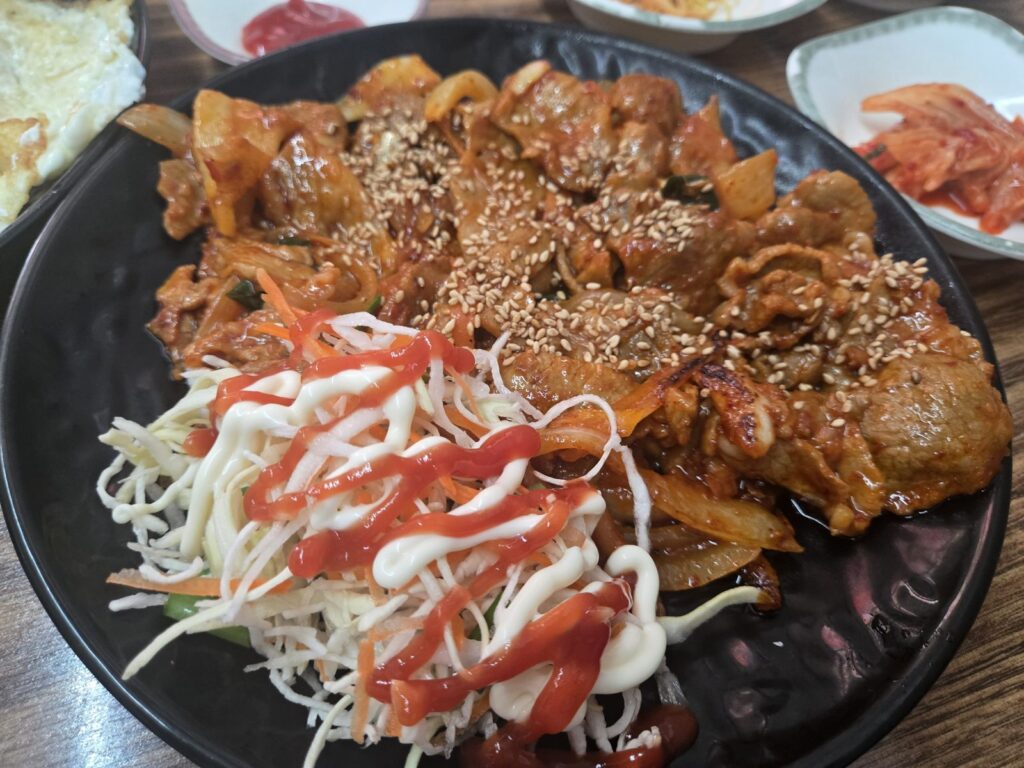
Dalnimine Seongsu jeyuk bokkeum plate with cabbage mayo ketchup
Jeyuk bokkeum at Dalnimine Seongsu — sesame seeds, onion, and a mayo-ketchup cabbage bed.

My colleague ordered the 제육볶음 (jeyuk bokkeum) for himself. So I didn’t think much of it at first — every Korean lunch spot does a version of stir-fried spicy pork. And honestly, half of them are forgettable, oversauced, with chewy frozen-import pork.

But two minutes after the plate landed, he pushed it across the table. “Try this,” he said. The pork was sliced thick — closer to bulgogi cuts than the paper-thin shavings you see at chains. Onion strands were just barely translucent, still crisp at the core. Sesame seeds blanketed the top. And the sauce — bright red, gochujang-led, with a slight sweet edge — wasn’t drowning anything.

Plus, the heat level was right for an office lunch. Spicy enough to wake you up, but mild enough that you weren’t going to spend the rest of the afternoon at the water cooler. For 11,000 KRW, this is the dish I’d order on a return visit if I were eating solo.

For context, I’ve eaten jeyuk bokkeum at four other Seongsu lunch spots in the last six months. Dalnimine’s plate beats the chain versions on three points — meat thickness, sauce balance, and the cabbage bed. And the only spot in this neighborhood I’d rate higher on jeyuk is a 14,000-won place near Konkuk that runs out of pork by 1 p.m.

The Cabbage-Mayo-Ketchup Bed Beneath the Jeyuk

Ketchup dipping dish and jeyuk bokkeum side angle Dalnimine
Detail shot at Dalnimine Seongsu — ketchup ramekin between the egg and the jeyuk bowl.

Underneath the pork sits a bed of shredded raw cabbage, drizzled with a Korean classic: white mayo and tomato ketchup in parallel zigzag stripes. So if you’ve eaten at a 70s-style Korean diner before, this is the visual signature.

And the cabbage isn’t decorative. As you eat the spicy pork, the cool, slightly sweet cabbage cuts the heat. The mayo softens the gochujang. The ketchup adds a mild sweetness that complements the pork’s sugar glaze. It works.

Also, the side plate held a tiny ramekin of pure ketchup. For someone like me — who never eats ketchup at home — this seemed redundant. But my colleague used it to dip his eggs into, claiming it “cuts the spam grease.” I tried it once. He was right.

Four Side Dishes That Punch Above Their Price

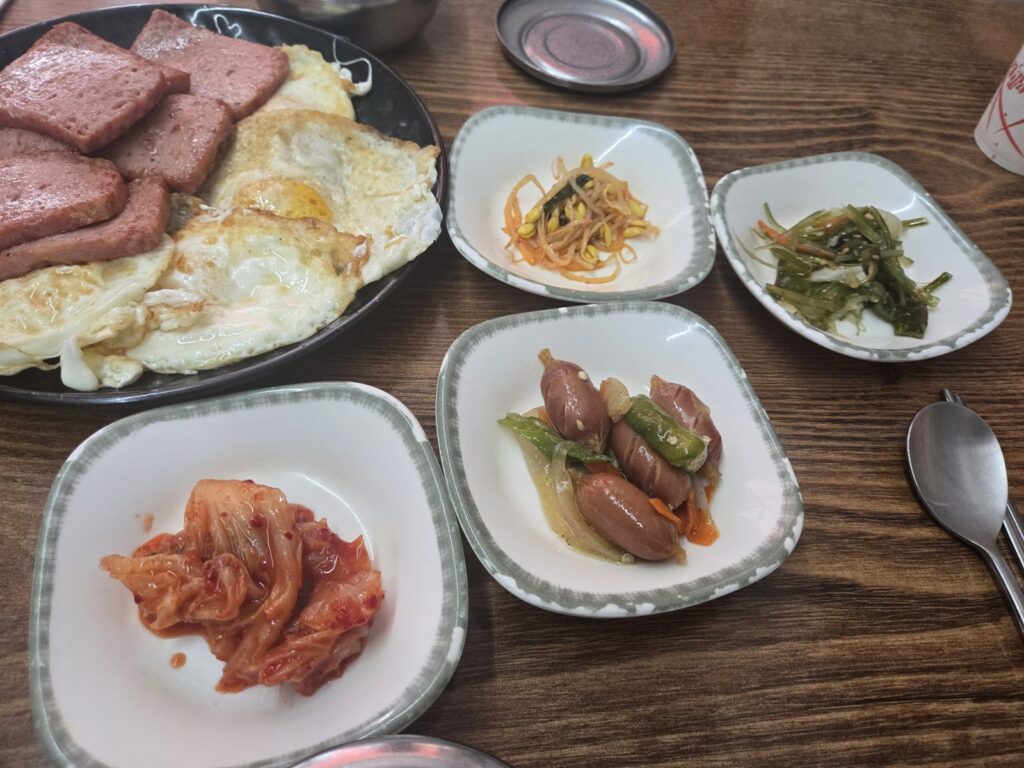
Dalnimine Seongsu banchan with kimchi sausage stir-fry sprouts kale
Banchan spread at Dalnimine Seongsu — kimchi, sausage stir-fry, sprout salad, kale namul.

Four small white dishes arrived with our mains, no extra charge. So this is standard Korean lunchroom etiquette: as many banchan as the kitchen wants to send out, refilled if you finish, included in the menu price. Comparable banchan generosity shows up at 502 Jjigae Maeul Konkuk a few stations over.

The first dish was poggi-style cabbage kimchi — bright red, fresh, with that early-fermentation crunch. So not overly sour, not bland. The second was a stir-fry of mini cocktail sausages with onion and green chili. The sausages were the cheap pink kind from the convenience store. Stir-fried in a sweet-spicy gochujang glaze, they worked as a kid-friendly side.

For the third, a kongnamul-style sprout salad with carrot threads, slightly sesame-oiled. Eventually you’d find it underwhelming at any other spot, but at Dalnimine the crunch held up. And the fourth was a wilted kale namul — boiled, squeezed dry, dressed with garlic and a touch of fish sauce. For an extra side, the kale was the surprise — most cheap lunch spots skip leafy greens entirely.

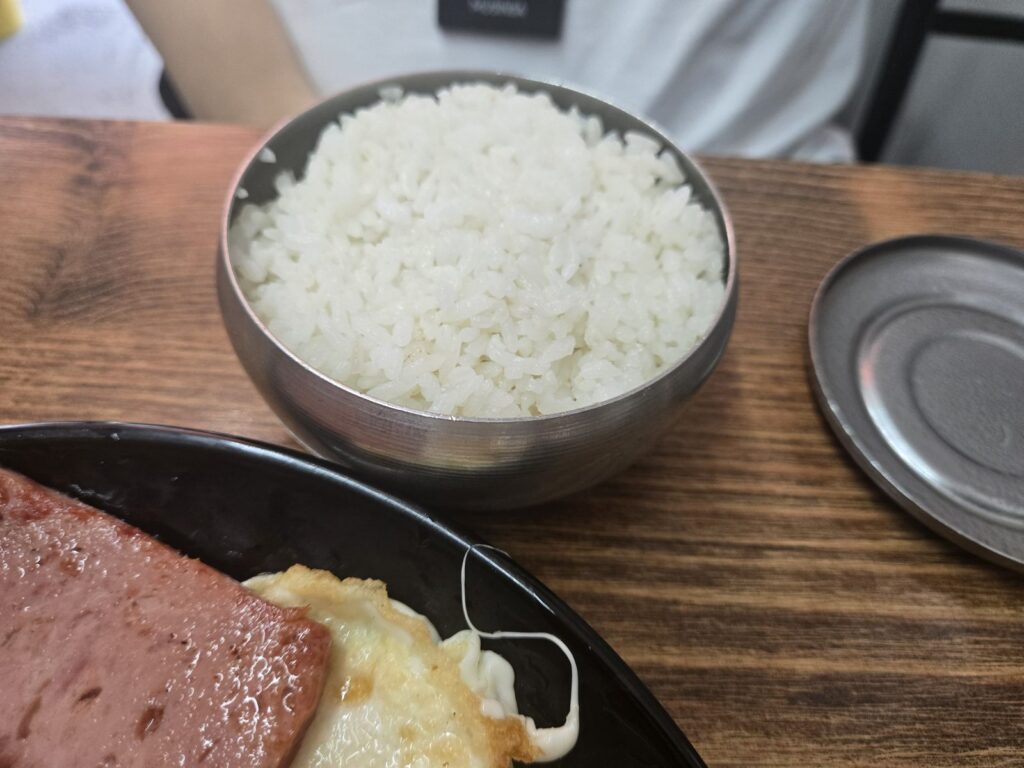
Stainless steel rice bowl beside spam plate Dalnimine
Stainless rice bowl beside the spam fry plate — Dalnimine Seongsu lunch portion.

And the rice came in old-school stainless-steel bowls with mushroom-stem lids. So 1,000 KRW each, freshly steamed, with the slightly sticky short-grain texture that defines a proper Korean home meal. We finished both bowls by the end of the spam plate, then ordered a third to share with the jeyuk leftovers.

The Ajumma Behind the Counter Runs This Whole Thing

Dalnimine Seongsu owner ajumma working in open kitchen
Owner ajumma working the open kitchen at Dalnimine Seongsu — TV news on, stacked bowls behind her.

Behind the rail, one ajumma in her fifties handles the entire kitchen. So she chops, stir-fries, plates, and carries — usually all at once. While we ate, she completed three full orders in about twelve minutes, with no apparent rush.

Also, she sets the tempo of the room. So when a couple of office workers came in slightly drunk after a long lunch meeting, she sent them home with steamed rice in foam containers and one disposable spoon. And when a pair of regulars sat down at table four, she had their orders plated before they’d taken off their jackets.

For an open kitchen the size of a small studio apartment, the operation is impressively quiet. No shouting between line cooks. No timer beeps. The TV plays the noon news on mute. The only sound is the steady hiss of the pan and the click of the rice cooker latching shut between batches.

And when she handed us our bill at the counter, she asked if we worked in the print shops across the street. We explained we were dev guys from a startup four buildings over. She nodded once. Then said, “Come back for the 낙지볶음 tomorrow. I save the fresh ones for the afternoon shift.” That kind of casual hand-off recognizes repeat customers before they’ve technically become repeat customers. It’s a small thing. But it separates a 4.7-star lunch spot from a 4.0.

Why Dalnimine Seongsu Works for an Office Lunch Crew

For an office team of four to six people, Dalnimine Seongsu is the ideal Seoul lunch spot. So you walk in at 12:15 p.m., grab a table, order three or four mains to share, and you’re back at your desk by 1:05 p.m. Total per-person spend lands at 8,000 to 12,000 KRW depending on what you ordered.

And the menu structure favors group ordering. With the spam fry (15,000) and jeyuk bokkeum (11,000) split between four people, plus two extra rice bowls, you’re at about 28,000 KRW for the table — seven thousand each. Add a Korean-style bibimbap or 떡볶이 and you’re still under 35,000.

Also, the kitchen is fast. Most plates land within nine or ten minutes of ordering, which matters when you’ve got a one-hour lunch window. And the ajumma never seems to push you to leave — once you finish, you stand up, pay at the counter, and walk out.

For nearby alternatives, Mongttang Saenggogi Seongsu is the better choice when the team wants Korean BBQ. But for office cafeteria-style comfort food at half the price, Dalnimine is hard to beat. So if your team rotates lunch spots weekly, this one earns its slot.

Practical Info: Address, Hours, and How to Find Dalnimine Seongsu

For first-time visitors, here’s everything you need to find and order at Dalnimine Seongsu without fumbling at the door.

  • 📍 Address: Seongsu-dong 1-ga, Seongdong-gu, Seoul (서울시 성동구 성수동1가)
  • 🗺️ Nearest station: Seongsu Station (Line 2), Exit 2 — about a 6-minute walk
  • 📞 Phone (for orders): 010-9354-9065
  • 🕒 Hours: Roughly 11:00 a.m. to 8:00 p.m., closed Sundays (confirm by phone)
  • 💰 Cash and card both accepted
  • 🥡 Takeout: Every menu item available for takeout — call ahead for faster pickup
  • 🍴 Seating: About 6 to 8 tables, mostly 2-tops and 4-tops
  • 👶 Kids: Welcome — no high chairs, but the menu has plenty of mild options like rice bowls and 떡볶이
  • 🌐 Online presence: None — no website, no Instagram, no delivery apps as of this visit

For directions from the station: take Exit 2 and walk east along the main road for about 300 meters. Then hook left at the print shop on the corner. The 달님이네 vinyl sign is two doors down on the right. You can also check the official Seongsu-dong area guide on VisitSeoul for the broader district map.

Final Verdict + Star Rating

For honest takes from someone who eats lunch in Seongsu twice a week, Dalnimine Seongsu sits in the rare category of office-block restaurants that consistently deliver. So the food is exactly what’s advertised. The portions match the price. The ajumma is fast, the cabbage is fresh, the spam is properly seared, and the jeyuk bokkeum is a legitimate reason to come back.

And here’s the rating breakdown:

  • ⭐ Food Quality: 4.5/5 — fresh ingredients, properly cooked, generous portions
  • ⭐ Price Value: 5/5 — most plates under 12,000 KRW with four banchan included
  • ⭐ Service Speed: 5/5 — orders land in 9-10 minutes
  • ⭐ Cleanliness: 4/5 — old-school diner clean, not Instagram-aesthetic clean
  • ⭐ Office-Lunch Fit: 5/5 — group menu, quick turnover, walkable from Seongsu Station
  • ⭐ Overall: 4.7/5

For my next visit, I’m bringing two more coworkers and ordering the 낙지볶음 — the only dish on the menu I couldn’t sample on the first round. Until then, this is going on the team’s shared lunch shortlist alongside our usual Dammion Seongsu for late-night gukbap and the Dammion second visit when we want bossam. For anyone who works in this corner of Seongsu, save Dalnimine’s phone number in your contacts — at some point, you’ll need a takeout order at 6:30 p.m. on a deadline night, and an ajumma who’ll plate it in twelve minutes is a serious asset.

Leave a Comment

Your email address will not be published. Required fields are marked *

Scroll to Top